Discover Bruges: A Journey Through Time and Tradition

June 3, 2025

Ah Bruges, Belgium. One of the most beautiful & most surprising cities in Europe. A perfectly preserved medieval city famous for its history, its canals, its primitive Flemish painters like Jan Van Eyck and Hans Memling, its many museums, its wonderful medieval brick Gothic architecture & Flemish brick building façades with their stepped gables, its Beguinage. The Venice of the North. A marvelously beautiful place where visitors are transported back in time. There is so much to discover and the city has a strong attachment to its traditions and its past, especially to its golden period from the 13th to the 15th centuries during which a lot of the major buildings & monuments were started or completed.

Bruges’ Golden era

If the city dates back to Roman times, it began to flourish as a commercial hub from the 12th century onwards, thanks to its strategic geographical location located at the cross roads of the northern Hanseatic League trade and to easy access to the North Sea. In the 12th century, a wool market and a woolen weaving industry and cloth market all flourished in Bruges and the weavers and spinners of Bruges were considered to be the best in Europe. In 1277, the first merchant fleet from the Republic of Genoa had already arrived in the Port of Bruges and trade in spices from the Orient developed. A Bourse was opened in 1309, probably the first stock market in the world. Venetian galleys arrived to trade in 1314 and the city was populated with numerous foreign merchants, notably Genoese, Venitians, Basques, Catalans, English and Scots. Traders in Bruges were the first to develop new forms of trade including the introduction of Bills of Exchange and letters of credit. The first book ever printed in English was printed in Bruges by William Caxton in 1464, entitled “Recuyell of the History of Troye“. The City became wealthy from its commercial activities and this wealth is reflected in the many fine houses, churches and monuments adorning the city. Impossible for us to describe here all the many discoveries we made in a short time but here are our favorites (for the moment).

1. The Procession of the Holy Blood, maintaining tradition since 1304.

We were lucky to arrive in Bruges for the Procession of the Holy Blood. Every year on Ascension Day, the Procession of the Holy Blood passes through the historic city center of Bruges with a relic of what is believed to be the Holy Blood of Jesus, brought back from the Holy Land by Thierry, Count of Flanders after the Second Crusade who it is claimed, received it from King Baldwin III of Jerusalem. Amazingly, the Procession was first created in 1304 as an expression of gratitude, faith & remembrance of the suffering of Jesus Christ. More than 1800 locals tale part participants singing, playing music, dancing and acting out scenes from the Old and New Testament. The day is also called in Dutch “Brugges Schoonste Day” meaning “The most beautiful day in Bruges“.

The spectacle is marvelously moving & its longevity seems a testament to the faith and resilience of the inhabitants of Bruges who continue to maintain the tradition just as their parents, grand parents and ancestors did before them.

2. The Jerusalem Chapel and the legendary life of Anselme Adornes

Equally extraordinary and moving is the beautiful and mysterious Jerusalem Chapel located in the Sint Ana district. An initial family home and Chapel was built by brothers Jan and Peter II Adornes whose deeply religious family had settled in Bruges in the 13th Century from Genoa, Italy. It was Peter’s son, Anselme, who had the initial chapel rebuilt as the Jerusalem Chapel, inspired by the Holy Sepulcher Church in Jerusalem with an oriental style tower.

The architecture, furnishings and remarkable relics in the Jerusalem Chapel illustrate the tremendous regard that the Adornes family had for Jerusalem and for their spiritual lives.

Anselme Adornes & Wife Margareta van der Banck

The life of Anselme himself was extraordinary. The family had become wealthy importing Alum into Bruges, used in the weaving, tanning and glass making industries and he became a highly influential trader and diplomat. When the Scottish parliament banned trade with Flanders, he led a mission to the Court of Scottish King James III and successfully negotiated an end to the ban. In gratitude, King James knighted Anselme knight of the Order of the Unicorn.

Anselme was extremely adventurous and undertook a pilgrimage to the Middle East with his son Jan to visit the Holy Sepulchre in Jerusalem.

Medieval graffiti: Anselme carved his name on a rock at St Catherine’s monastery, Sinai

He travelled via Genoa on to Rome, then Tunis, Egypt, & the Sinai where he stopped off at the famous Monastery of Saint Catherine in the Sinai as he was devoted to Saint Catherine. The return journey took him through Damascus, Beirut, Cyprus, Rhodes and Brindisi. Quite a dangerous journey at the time.

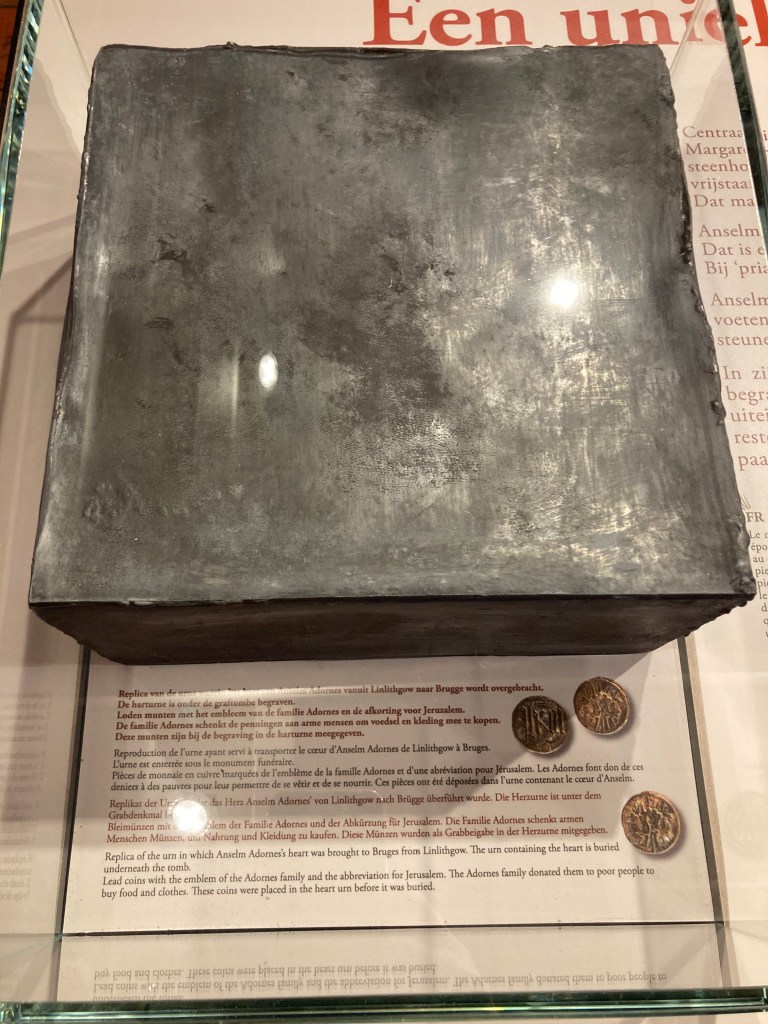
However, an uprising erupted in Bruges in 1477 and he was arrested twice, tortured and accused of self-enrichment. Anselm had to pay a severe fine and he left Bruges for Scotland. This was to prove fatal. Although he quickly re-established himself as one of James III’s close companions, was appointed keeper of the king’s palace at Linlithgow and survived the rebellion against the king in 1482, he was murdered in the following year in circumstances which remain obscure. His body is interred at Linlithgow, Scotland but his heart was returned to Bruges to be buried alongside his wife in the Jerusalem Chapel. Extraordinary.

The lead box used to transport Anselme’s heart back to Bruges

A diplomat, politician, trader & pilgrim, Anselme is considered a humanist. During his travels, he showed great interest for other cultures that were considered equal. “There is only one road to heaven, and it is equally long from all corners of the world“, his son wrote in his account of their travels to the Middle East. A truly extraordinary place to visit.

Not to forget that Anselme Adornes was also a benefactor of the poor. The museum in the grounds of the Jerusalem Chapel was built initially by him as alms houses for women in need that were still in use until the 1970s!

Equally extraordinary is the fact that the current owners of the Chapel are the 17th Generation of the Adornes family. What longevity!

3. Saint John’s Hospital a place of care and caring since the 12th century

Located in the centre of Bruges beside the Church of Our Lady, the visitor will find the magnificent Saint John’s Hospital (Old Sint-Janshospitaal) which houses a collection of paintings, triptychs & reliquaries by one of the figureheads of 14th century Flemish Primitive artists, Hans Memling who moved to Bruges in 1460 and who created 4 of his 7 masterpieces in the hospital. Founded in the 12th century, the Hospital grew in the Middle Ages and was a place where sick pilgrims and travellers were cared for. Amazingly, a part of the hospital was still in use up to 1977. The Hospital houses an exhibition dedicated to medical care through the centuries and visitors can discover with some anguish the medical care delivered over the centuries for illnesses such as kidney stones, cholera, the plague,…..Not for the squeamish.

Saint John’s Hospital reminds current day visitors that “hospitality is the art of receiving guests and that the hospital was a home, a shelter for people in need. The paintings in the collection provide for this art of hospitality do’s and don’ts for those who receive guests. Put good food on the table? Do, of course. Turn people away for being different? Don’t“. A wonderful visit.

4. The Book of Hours at the Groeningemuseum

Despite the booming trade and commercial growth, the 14th and 15th centuries were hard times indeed for Bruges’ citizens with epidemics, famines and wars ravaging Europe. In uncertain times, faith provided a source of stability. More and more people could read and they could take their faith and salvation into their now hands through the use of small book of hours/prayer books.

At the Groeningemuseum, you can discover a fascinating exhibition entitled “Pride & Solace” (Trots en Troost) of these medieval prayer books used by rich and poor alike. Books of hours contained daily prayers recited by clergy in Church and the Hours were the 8 prescribed times of daily prayers: matins, lauds, prime, terce, sext, none, vespers and compline. In addition to the Books of Hours (perhaps on temporary display), you can discover masterpieces from Flemish masters Jan van Eyck & Jheronimus Bosch who painted “The Last Judgement” between 1495 & 1505. Extraordinarily beautiful and enriching.

5. The Belfry

Of course, a trip to Bruges without paying a visit to the famous Belfry in the Market square is impossible. First built in 1240, the upper part three times destroyed and three times rebuilt, it today stands at 83 meters in height. A narrow staircase of 366 steps leads to the top and it certainly is good exercise to climb up to the top.

Along the way, you can discover the treasury where the City’s charter was once stored behind double wrought-iron gates and further up can be found the music drum that controls the carillon of 47 bells weighing in total more than 27 tons. The Carillon plays on Wednesdays, Saturdays and Sundays. Once at the top, the panoramic view of Bruges is breathtaking. well worth the effort and after all, no pain, no gain.

6. Out & about in Bruges

Having visited all the great museums and monuments, it remains a joy just walking around the city and along the canals, works of art in themselves. The city centre is small and it is easy to find your way around. What is remarkable is the general cleanliness of the streets generally free from litter and graffitti and there are lots of parks and green spaces populated with swans, ducks, and other wild life. A place to stroll around. A special mention to the Café Vlissinghe in Blekkerstraat, serving customers apparently since 1515. We recommend the Flemish carbonade. Eet smakelijk. Bon appétit!

Een prachtig verblijf in een prachtige stad. A beautiful stay in a beautiful city. We will definitely return. Win zullen terugkeren. Uitstekend.


Journal d’un paddle boarder-Le tropical race de Genève.

May 20, 2025

Festina lente. Hâte-toi lentement.

Aah! Genève, la Suisse. Son vieux quartier, sa Cathédrale de Saint Pierre, ses organisations internationales, ses grands hotels, ses banques, ses montagnes, ses horlogers, son chocolat, son jet d’eau, son Lac Léman magnifique, ses hommes et femmes célèbres (Jean Calvin, JJ Rousseau, Henri Dunant, Albert Schweitzer,…). Un petit weekend dans la cité helvétique pour découvrir tout cela et plus et aussi et surtout pour participer au Tropical Race, une magnifique course de 10 km de Stand Up Paddle sur le lac de Genève/Léman.

Le départ était donné le dimanche matin 18 mai à 10 heures à proximité de la plage du Tropical Corner, Quai de Cologny. Si les conditions n’étaient pas “tropicales”, elles étaient certainement plus que parfaites. Ciel bleu, quelques nuages cotonneux paresseux, presque pas de vent, soleil radieux et bienveillant, eaux pristines, calmes et invitantes. Pas beaucoup de mouvement sur l’eau, à part quelques petits bateaux à moteur ou zodiac dont les vagues générés par leur passage au loin s’estompaient rapidement.

Nous étions une cinquantaine d’intrépides à nous lancer à l’assaut du Lac Léman sur 10 kms dans une ambience bon enfant et festive. C’est cela qui plaît toujours dans les courses de SUP. Personne ne se prend au sérieux, même si tout le monde fait les choses sérieusement (sur l’eau, il faut toujours rester humble et faire attention aux règles de sécurité). Les compétitions et courses sont toujours ouvertes à toutes et à tous et se déroulent en général dans une ambience de fête et de sympathie. Des courses de catégories différentes sont toujours organisées (courses enfants, sprints, courses courtes et longues distances) pour satisfaire tous les niveaux et c’était le cas pour le Tropical. Les équipes organisatrices sont toujours très accueillantes, bienveillantes, disponibles, à l’écoute, de bon conseil. C’était certainement le cas pour l’organisation du Tropical Race. Bravo à toute l’équipe.

Et puis c’est parti et on y va tranquillement. Enfin, moi j’y vais tranquillement. Certes il y a des participants qui se donnent à fond toute de suite. Mais pour ma part, n’ayant pas fait une course de longue distance depuis “un certain temps” et ne connaissant pas bien le parcours ni les conditions plus loin sur le Lac, j’ai fait mienne la devise de l’empereur Auguste “Festina Lente-hâte-toi lentement“.

Je dois avouer que je voulais aussi profiter de la beauté des lieux, les berges, les montagnes du Jura au loin, la majesté du plan d’eau qui semblait s’étendre à l’infini devant moi.

Quand j’y pense, il y a quelque chose de spirituel, voire de mystique dans la pratique du Stand Up Paddle. Quand on est sur l’eau dans un environnement aussi majestueux et naturel, on a souvent le sentiment d’être proche de l’essentiel. Très vite, chacun est dans sa course et se concentre sur sa tâche de pagayer. On se focalise sur le mouvement de l’eau, les petites perturbations sur l’eau qui risquent de perturber l’avancement de sa planche. On essaie de maintenir une cadence rythmée qui permet de tenir la distance sans trop forcer. Car 10 KM sur l’eau est long pour des escargots comme moi et il faut penser à bien doser ses efforts pour finir dans de bonnes conditions.

Et puis, le monde semble différent vu d’une planche gonflable à 50 mètres des rivages. On oublie les tracas du quotidien pour concentrer son énérgie sur la recherche d’une satanée bouée placée à 5 km du départ pour pouvoir enclencher la virée du retour vers la ligne d’arrivée et qui semble se trouver très, très loin. Et tout-à-coup, elle est là. Enfin! Et une surprise attend. Car, une fois la bouée rouge virée, on traverse le lac sur 20 mètres en direction du rivage pour contourner une bouée verte où une jolie sirène sur son rocher nous attend. Ca y est. on a fait la moitié du chemin et il ne reste que 5 km à faire (tout de même)!

L’envie d’arriver est forte, certes, mais je ressens une envie aussi forte de traîner un peu sur ma planche pour profiter du spectacle grandiose: les avions qui décollent ou atterrissent comme des cygnes à l’aéroport de Genève au loin avec les montagnes du Jura à l’arrière plan, les bateaux qui passent sir l’immense plan d’eau au loin, les remous sur l’eau qui obligent à accélérer subitement si on ne veut pas se faire renverser. Il faut constamment scruter l’eau pour profiter de la moindre vague qui pourrait pousser vers l’avant ou manoeuvrer en toute vitesse pour éviter d’être ralenti.

Et puis, de temps en temps, le bateau course qui vient me rappeler qu’il faut arrêter de se prélasser sur l’eau et qu’il faut bien finir la course un jour. Merci d’ailleurs aux équipes de sécurité qui ont bien veillé au grain et étaient toujours là pour motiver les retardataires.

Enfin, la ligne d’arrivée est en vue. Encore un petit effort mon petit Joseph. Il ne reste plus qu’à contourner la bouée rouge devant la ligne d’arrivée devant le Tropical Centre avant de couper la ligne debout sur sa planche (sous peine de disqualification!). Pas le moment de tomber.

Ouf! Ca y est. C’est fait. Hallelujah! La ligne d’arrivée est coupée. Un peu fatigué mais tout va bien et quelle sensation de satisfaction. Une bonne bière fraîche (voire deux) nous attend. Après l’effort, le réconfort!

Comme prévu, un temps de 2 heures et 5 minutes n’était pas parmi les plus rapides mais comme disait le grand sage Confucius, “il n’est pas nécessaire d’aller vite. Le tout est de ne pas s’arrêter“. Quelle jolie course. Bravo aux organisateurs, au vainqueur, à tous les autres compétiteurs et à toutes les autres compétitrices. Quelle façon magnifique de découvrir la ville de Genève. Même s’il y a encore beaucoup de voitures, je ne peut qu’être impressionné par la majesté de son Lac, par les plages bondées de monde et les espaces de verdure et de jeu qui permettent aux habitants et aux visiteurs de profiter de la nature.

J’y retournerai avec joie, d’autant plus que maintenant je connais un joli coin “tropical” où je pourrais poser ma planche. Il y a bien d’autres jolis coins autour du lac Léman et bien au-delà en Suisse bien sûr. Il y a aussi d’autres jolies courses dans le programme de l’Alpine Lakes Tours de 2025. https://alpinelakestour.com. Je m’y prépare déjà!

Si vous souhaitez pratiquer le stand Up Paddle en lac ou en mer, voici les règles de sécurité de base que j’applique:

  1. Utilisez un leash et portez un gilet de sauvetage
  2. Vérifiez toujours le matériel avant de sortir
  3. Portez les vêtements adaptés (casquette, lunettes de soleil, combi, chaussures adaptées,..)
  4. Vérifier la météo avant de sortir. Le vent est l’ennemi du SUPer. Ne sortez pas si le vent souffle de la plage vers l’eau.
  5. Sortez à plusieurs
  6. Dites à quelqu’un que vous sortez si vous partez seul
  7. Amenez suffisamment d’eau et quelque chose à manger
  8. Respectez les autres présent sur l’eau et soyez vigilants toujours
  9. N’oubliez pas la crème solaire, même par temps nuageux
  10. Restez humbles. La nature est plus forte toujours.

Happy paddle! Enjoy.

Salutations à tous mes ami(e)s suisses. Vous avez certainement un très joli pays.

Et n’oublions pas le célèbre jet d’eau de Genève. Quel spectacle!

Stop aux incivilités et impolitesses au travail!

May 5, 2025

Selon des recherches menées par Christine Porath, Professeur en Management à Georgetown University et de Christine Pearson, Professeur en Global Leadership à Thunderbird, Arizona, plus de 50% des salariés interrogés estiment ne pas être respectés par leurs employeurs et ont déclaré avoir été victimes d’incivilités au moins une fois par semaine sur leur lieu de travail. Ces incivilités au travail englobent un éventail de comportements inappropriés qui, bien que non violents, créent un environnement de travail hostile. Elles incluent les remarques désobligeantes ou insultantes, des commérages, des blagues de mauvais goût, ne pas dire bonjour aux autres, passer son temps à faire des critiques non constructives, couper la parole, adopter un mauvais comportement en général, ne pas répondre aux appels ou emails dans des délais raisonnables, arriver systématiquement en retard pour les rendez-vous ou réunions,…. 

Ces résultats ne sont pas étonnants. On a tous l’impression que les incivilités et impolitesses petites et grandes augmentent à la fois au travail et dans la société en générale. Dans un environnement professionnel, ces incivilités et impolitesses prennent différentes formes et peuvent être commises par des managers, des subordonnées ou par des collègues.

Au travail, on a peut-être connu ou croisé un hiérarchique autoritaire, voire tyrannique qui harcèle ses collaborateurs, les insulte, ne reconnaît jamais les efforts fournis, voire dévalorise le travail fait, qui accuse les autres de ses propres torts, qui prend le crédit pour le travail fait par les autres, qui n’hésite pas à critiquer ou émettre des remarques désobligeantes devant d’autres, qui interrompt sans cesse, qui hausse le ton ou qui s’énerve quand il/elle n’a pas ce qu’il/elle attend, qui pense tout savoir et fait à la place des autres, ne reconnaissant jamais le périmètre des autres.

Ou encore un collègue ou subordonné qui ne dit jamais bonjour, qui ignore ses collègues, qui répond jamais aux emails, arrive systématiquement en retard, qui coupe la parole des autres, qui écrit ses emails ou consulte sans cesse son smart phone en réunion, qui n’hésite pas à critiquer les autres devant la machine à café, voire passe son temps à répandre des commérages et rumeurs autour de lui sur des collègues, son manager, la Direction, qui prend les autres de haut, qui ne dit jamais merci,…

Ces incivilités et impolitesses sont souvent des irritants qui pris isolement ne sont pas graves en soi mais qui peuvent avoir des conséquences importantes quand ils sont répétés et/ou deviennent la norme au sein d’une équipe.

Ces incivilités et impolitesses ont certainement un impact important selon les salariés interrogés par Porath et Pearson. En effet, face à de tels comportements:

  1. 48% des salariés interrogés ont admis avoir délibérément réduit leur investissement au travail
  2. 47% ont réduit leur temps passé au travail
  3. 38% ont délibérément réduit la qualité de leur travail
  4. 80% ont perdu du temps de travail en s’inquiétant des conséquences de ces incivilités à leur égard
  5. 63% ont perdu du temps de travail en évitant les auteurs de ces incivilités
  6. 66% ont estimé que leur performance au travail a été dégradée
  7. 78% ont estimé que leur engagement envers l’organisation a été érodé
  8. 12% ont affirmé qu’ils ont quitté l’entreprise à cause de ces incivilités
  9. 25% ont admis évacuer leurs frustrations sur les clients

Parmi les conséquences de ces comportements inciviles:

  • La créativité des salariés en prend un coup

Les recherches de Porath et Pearson suggèrent que les salariés traités d’une manière incivile ou discourtoise ont tendance à être moins créatifs que les salariés traités avec respect. Ils produisent moins d’idées et ces idées étaient moins originales. Les salariés ou équipes exposées à l’impolitesse, que ce soit de la part des collègues, des superviseurs ou de clients, ont montré une réduction du partage des informations et du partage de la charge de travail, deux éléments essentiels à la performance d’une équipe.

  • La performance et l’esprit d’équipe sont dégradés à la fois pour les victimes et pour les témoins.

Ce n’est peut-être pas étonnant que la performance et l’esprit d’équipe des victimes de ces comportements en soient impactés. Mais les mêmes études montrent que ces impolitesses ont un effet négatif non seulement sur les salariés directement visés mais également sur les salariés témoins de ces comportements, même si ceux-ci ne sont pas directement ciblés. Non seulement les témoins de ces comportements faisaient preuve de moins de créativité et étaient moins productifs mais ils étaient également moins disposés à aider les autres, même quand le salarié à aider n’avait aucun lien hiérarchique avec le salarié auteur du comportement incivile ou avec le salarié victime. Ces comportements hostiles contribuent donc à la démotivation et au désengagement des salariés, à la mauvaise coopération, à la mauvaise qualité, au “quiet quitting” et au taux de démissions des salariés.

  • Les clients rejettent les cultures d’entreprises “inciviles”.

Les comportements inciviles ont un impact négatif sur les clients. Nous sommes tous allergiques au manque de respect et les salariés victimes de comportements inciviles risquent d’adopter ces mêmes comportements inciviles dans leurs relations avec les clients. Pire, les études montrent que les clients témoins de ces comportements (par exemple un responsable qui critique un collaborateur devant un client ou un salarié qui critique un collègue au même client) préfèrent aller ailleurs que de cautionner un comportement qui dégrade un interlocuteur chez son fournisseur.

  • Gérer les incidents résultant de ces comportements inciviles prend beaucoup de temps

Tout responsable RH et/ou manager sait que gérer les conséquences de ces incidents prendre beaucoup trop de temps qui aurait pu être mieux utilisé sur des sujets plus critiques pour l’entreprise. Porath et Pearson font référence à une de leurs études qui indique que les managers au sein des sociétés Fortune 1000 passent 13% de leur temps de travail à gérer les conséquences de ces comportements.

Que peut faire un Leader face à la montée de ces incivilités toxiques?

  1. Donner l’exemple

Tout escalier se balaie par le haut. Les leaders donnent le ton et tout manager doit d’abord être conscient de son comportement et de l’impact de son comportement sur les autres. Selon Porath et Pearson, 25% des managers qui ont admis s’être mal comportés envers des collaborateurs ont affirmé qu’ils avaient pris l’exemple sur leurs N+1!

On a les comportements que l’on rémunère. Si une organisation non seulement tolère des comportements inciviles chez un manager mais valide ce comportement en promouvant ce manager au sein de l’organisation, on donne un signal clair à tous sur les comportements à adopter pour réussir au sein de l’organisation. Pour réduire, voire éliminer ces comportements inciviles, le leader doit donc donner l’exemple et la Direction doit valoriser les bons comportements et pénaliser les incivilités. Difficile de demander aux autres de couper leur portable en réunion si le leader ne le fait pas. Difficile de demander à un chef d’équipe de reconnaître ou saluer la performance de ses collaborateurs si sa hiérarchie ne le fait pas vis à-vis de lui. Difficile de demander à un collaborateur de ne pas couper la parole de ses collègues en réunion si sa hiérarchie lui fait subir le même traitement

2. Demander du feedback à ses collaborateurs

Les perceptions sont plus importantes que les intentions et il ne faut pas hésiter à solliciter les avis de ses collaborateurs si un leader veut ajuster son comportement tout en donnant l’exemple. Porath et Pearson suggèrent aux managers de tenir un journal avec des exemples de comportements inciviles au sein de leurs équipes et de noter les actions correctives à prendre.

3. Suivre son progrès et celui de son équipe.

On ne manage pas ce que l’on ne mesure pas et il est important de suivre son progrès dans le temps. Si on ne se donne pas des objectifs pour réduire, voir éliminer les incivilités au sein de son organisation, si on ne prend pas des actions pour atteindre ces objectifs et si n ne mesure pas les résultats, il est certain que rien ne se passera, les incivilités continueront à se propager et les conflits interpersonnels se proliférant.

4. Prendre des mesures au niveau de l’organisation

Il ne suffit pas de prendre des mesures au niveau individuel. Il faut aussi prendre des actions au niveau de l’organisation dans son ensemble.

  • Faire de la civilité un critère de recrutement

Il va de soi que mieux vaut prévenir que guérir et autant que possible, éviter de recruter des collaborateurs qui ont un potentiel de comportement incivile. Impliquer l’équipe dans le recrutement pour leur permettre d’évaluer leur futurs collègues. Utiliser les tests d’évaluation qui permettent d’évaluer l’intelligence émotionnelle et les capacités d’intégration des futurs candidats. Aborder le sujet des comportements inciviles en entretien d’embauche avec les candidats pour mesurer leurs réponses. Porter attention à la ponctualité des candidats, leur façon de s’exprimer, les propositions qu’ils proposent pour résoudre des potentiels conflits au travail. Demander des références aux candidats surtout pour des postes d’encadrement.

  • Former les managers à l’importance de l’empathie et de l’intelligence émotionnelle

Selon Porath et Pearson, étonnamment, certains managers et salariés interrogés ne savent pas faire la différence entre des comportements civiles et inciviles. 25% des salariés sondés n’ont pas reconnu certains comportements comme étant inciviles ni les impacts négatifs sur leurs interlocuteurs. Il est donc important de définir ce que l’on attend de chacun en termes de comportements civiles au travail. La civilité pour être apprise, l’intelligence émotionnelle et l’empathie peuvent être réveillées et/ou développées pour créer une culture de travail positif: Dire bonjour et au revoir, sourire, pratiquer une politique portes ouvertes, aborder les sujets difficiles avec les collègues directement au lieu d’échanger des emails, éviter les propos critiques incendiaires visant la personne, louer en public et critiquer en privé quand on est manager, donner du feedback constructif qui ne met pas en question la personne mais focalise sur le comportement à améliorer, rassurer le collaborateur, ne pas couper la parole, laisser les autres s’exprimer avant de s’exprimer, reformuler pour vérifier que l’on a bien compris, arrêter d’écrire ses emails en réunion, respecter les agendas des uns et des autres, arriver heure, répondre aux emails et appels, la liste est longue de comportements simples à adopter et à systématiser pour rendre l’environnement de travail plus positif et productif.

  • Mettre en place un code éthique

Au lieu d’imposer des règles sur ses collaborateurs, lancer une discussion au sein de l’équipe sur les bons comportements civiles à adopter et les mauvais comportements à écarter. Généraliser le débat au sein de l’organisation pour créer et maintenir une culture organisationnelle de la civilité et de la politesse. Rédiger ensuite une charte de bonne conduite qui résume les bons comportements à encourager et les mauvais comportements à éviter avec des exemples concrets. Intégrer ce code dans le processus d’intégration des nouveaux salariés et dans les revues annuelles.

  • Récompenser les bons comportements

Finalement, il faut évaluer non seulement la performance individuelle mais également la performance collective lors de la revue annuelle qui doit clairement permettre aux managers d’évaluer les comportements civiles attendus au travail. Souvent comme rappelle Porath et Pearson, les revues annuelles insistent plus sur les livrables business au détriment de l’impact du collaborateur sur le collectif. Atteindre ses objectifs individuels au détriment de ses collègues et/ou de l’équipe érode la performance collective à moyen terme.

  • Pénaliser les mauvais comportements

Evidemment, il faut aussi pénaliser les mauvais comportements. Trop souvent, les entreprises laissent passer les incidents et comportements inciviles de certains collaborateurs, voire récompensent ces managers pour leurs performances techniques en ignorant le mauvais comportement de ces collaborateurs envers leurs collègues et/ou équipes.

Il faut donc permettre aux salariés de remonter en interne des comportements inciviles dont ils s’estiment victimes, traiter chaque plainte sérieusement et donner un retour au salarié concerné sur les actions prises. Il faut surtout agir rapidement. Porath et Pearson cite un directeur qui reconnaît que les erreurs commis concernent des actions prises trop tardivement pour traiter ces situations et non pour avoir agi trop tôt.

Trop souvent, les entreprises sont focalisées sur les résultats financiers ou commerciaux et insister sur une culture de civilité semble être un luxe, voire extravagant. Il suffit néanmoins d’un seul manager ou collaborateur positionné à un niveau stratégique au sein de l’organisation pour que ses incivilités occasionnent des coûts importants pour la société en termes de turnover, de clients perdus et de productivité dégradée.

Pour conclure, au lieu d’être des irritants mineurs, les incivilités et impolitesses au travail impactent la performance des équipes et génèrent des conséquences importantes pour l’entreprise et pour ses salariés: stress, mauvaise qualité et erreurs, retards, insatisfaction des clients, démotivation, désengagement, quiet quitting, démissions. Parfois les conséquences peuvent être graves. D’autres chercheurs à l’Université de Floride, USA, ont découvert que l’impact de ces incivilités est disproportionné à son intensité et que même des comportements inciviles mineurs peuvent générer des conséquences beaucoup plus importantes et notamment au sein d’équipes médicales où la coopération, la solidarité et le partage des informations dans la délivrance de soins critiques sont primordiales. Il ne faut donc pas traiter les incivilités au travail comme mineures ou marginales mais les traiter comme des agents toxiques à combattre, comme on combattrait un virus.

Pour aller plus loin:

https://www.francetvinfo.fr/replay-radio/le-billet-vert/pour-plus-d-efficacite-collective-au-travail-soyez-polis-avec-vos-collegues_6676776.html

Découvrez Christine Porath sur Ted Talks.

Négocier un accord de télétravail avec les partenaires sociaux-10 recommandations

February 24, 2021

LE TELETRAVAIL – BEAUCOUP D’ACCORDS D’ENTRERPRISE EN VUE EN 2021

Les DRH en France vont être très occupé(e)s dans les mois à venir à préparer et à négocier des accords d’entreprise sur le télétravail.

A ce sujet, des experts de L’Agence Nationale pour l’Amélioration des Conditions de Travail (ANACT) viennent de réaliser une étude très intéressante et approfondie des accords de travail et chartes d’entreprises signés en France entre les entreprises et les partenaires sociaux en 2020. Plus de 6000 textes mentionnant le Télétravail ont été signés pendant cette période.

Il en résulte de cette étude 10 recommandations pour les entreprises souhaitant mettre en place un accord de travail ou une charte d’entreprise sur le télétravail en 2021.

1.Prévoir des accords de télétravail adaptables: on constate rarement la bonne formule de télétravail, la bonne organisation et les bonnes pratiques managériales adaptées. En effet, la nature soudaine du mouvement en masse vers le télétravail en mars 2020 a laissé peu de temps aux entrerprises pour réfléchir sur la meilleure façon d’organiser et mettre en oeuvre le télétravail. Comme toute nouvelle organisation de travail se teste dans la durée, par conséquent, il est recommandé dans tout nouvel accord de définir un cadre ajustable avec les possibilités de revoir l’organisation mise en place avec les partenaires sociaux (Syndicats, CSE, etc.) et les salariés et de prévoir des bilans annuels pour pouvoir évaluer les forces et faiblesses de l’organisation de travail mise en place et les actions à mettre en eouvre pour l’améliorer. Intégrer la possibilité d’adapter tout nouveau mode d’organisation autour du tététravail dans un futur accord est ici le maître mot.

2. Bien identifier les Activités télétravaillables: Il n’est pas nécessaire qu’un métier ou une fonction soit entièrement télétravaillable pour qu’un salarié puisse bénéficier du télétravail. Certains postes de travail sont certes plus facilement télétravaillables que d’autres. Ceci étant dit, dans un souci d’équité de traitement, chaque poste de travail devrait être analysé pour identifier quelles activités peuvent être télétravaillables, notamment en mode dégradé en télétravail exceptionnel. Dans un esprit d’équité de traitement, il est important d’analyser dans le détail chaque poste avant de décider si tel ou tel poste est télétravailable ou non.

3. Privilégier l’apprentissage et les retours d’expérience sur une application rigide des règles: Le télétravail ne va pas de soi, d’autant plus que beaucoup de managers et salariés découvrent le télétravail pour la première fois dans des environnements peu habitués au travail à distance. Certains accords déjà signés prévoient des clauses de reversibilité qui donnent aux managers et aux collaborateurs la possibilité de mettre fin au télétravail après un délai de prévais. Compte tenu de la nouveauté du mode d’organisation en télétravail et la période d’apprentissage nécessairement plus ou moins longue avant d’arriver à un mode de fonctionnement plus ou moins efficace, il est recommandé de favoriser une dynamique d’apprentissage, le dialogue et le retour d’expérience entre les managers et les collaborateurs avant de prendre des décisions d’interrompre le télétravail pour un ou plusieurs collaborateurs. Le maître mot ici est apprentissage et retur d’expérience.

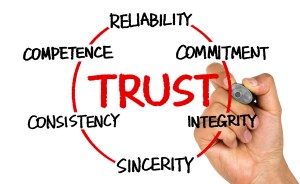
Un rapport de confiance entre manager et collaborateur

4. Privilégier des accords souples et des procédures de télétravail légers: le télétravail représente un bouleversement, voire une révolution par rapport à l’organisation du travail traditionnelle basée sur la présence du salarié dont le travail est contrôlé en direct par son manager. Certains managers pourraient être tentés d’insister sur des procédures administratives plus lourdes pour compenser un sentiment/perception de perte de contrôle directe de l’activité de leurs salariés.

Mais accroître ou alourdir les procédures administratives de contrôle serait chronophages et contreproductives et il est recommandé de privilégier plutôt des mesures de contrôles souples basées sur la confiance. En effet, le télétravail impose un changement de paradigme managérial où les méthodes “classiques” de contrôle sont remplacées par un rapport basé sur la confiance et la responsabilisation de chacun. Etant donné que le télétravail amène les collaborateurs à focaliser davantage sur les résultats et contribue à accélerer la réactivité des équipes, alourdir le télétravail par des procédures administratives accrues ferait perdre tous les avantages de ce mode d’organisation de travail. La souplesse, la flexibilité, la confiance et l’accompagnement sont ici les maîtres mots.

5. Envisager des alternatives en termes de lieux de travail/télétravail: Si le télétravail représente un avancé certain pour beaucoup de salariés, tel n’est pas le cas pour tous. En effet, tous les salariés ne disposent pas des conditions optimales pour pouvoir télétravailler (manque de place, manque d’équipements, appétence pour le télétravail, etc.). Par ailleurs, beaucoup de salariés, par ailleurs satisfaits de la possibilité de télétravailler, ont exprimé néanmoins un souhait de retourner au bureau au moins 1 ou 2 fois par semaine pour pouvoir retrouver le collectif et le lien social avec leurs collègues. C’est pourquoi il est recommandé d’envisager des formes d’organisation de travail hybride avec des périodes de travail en télétravail et des périodes au bureau. Ou de prévoir d’autres lieux de travail pour des télétravailleurs si le travail à domicile est exclu ou pas possible pour des raisons méterielles. Compte tenu de la grande diversité des cas, plus il y a de la flexibilité dans les solutions offertes aux salariés, plus on collera aux réalités des effectifs.

6. Anticiper les impacts sur les métiers et compétences au-delà des équipements et TIC: il est évident que le télétravail ne se résume pas à la mise à disposition d’équipements et de technologies facilitant le travail à distance. Le télétravail bouleverse l’organisation du travail, rompt avec l’unicité des lieux, du temps et de l’action, impacte les métiers et les compétences des collaborateurs et bouleverse les processus et procédures de travail qui risquent de ne plus correspondre à une réalité où les collaborateurs ne travaillent plus d’une manière synchrone dans un seul lieu. C’est pourquoi il est recommandé certes de former les collaborateurs à l’utilisation des différents outils de communication mais également une attention toute particulière doit être apportée aux impacts du télétravail sur les transformations des métiers, des compétences, des processus et procédures internes. Les maîtres mots ici sont “anticiper les impacts en mieux accompagnant les managers et les collaborateurs en développant leurs compétences”.

7. Veiller au Temps de travail et Charge de travail de chacun: Le temps de travail connecté ne dit pas grande chose du travail réel effectué par les salariés à distance. En effet, il faut bien plus de temps souvent pour préparer en amont certains sujets ou accéder aux informations pertinentes détenues par un autre collaborateur en télétravail que lorsque toute l’équipe était réunie au même moment au même bureau. Le rôle du manager devient encore plus important dans la régulation du temps de travail et dans la régulation de la charge de travail de chaque collaborateur. Chaque manager doit prévoir plus de moments d’échanges à la fois avec chaque collaborateur et avec l’équipe pour veiller au temps de travail de chacun et à la charge de travail de chacun.

8. Veiller aux risques de surconnexion: Tous les accords signés rappelent l’importance du respect des règles concernant le temps de travail et de repos quotidiens et hébdomadaires mais il est recommandé de ne pas se limiter aux seuls rappels de la législation. Il est donc recommandé de s’intéresser aux causes de tout dépassement (surcharge de travail, absence ou défaut de communication et de régulation, difficultés dans l’équipe, surconnexion numérique, déséquilibre présentiel/distanciel, etc. Le télétravail amène une grande flexibilité en termes d’organisation de travail qui distend les liens entre les collaborateurs et cette dispersion impose encore plus de contraintes sur les managers en termes de gestion, d’adaptabilité et d’écoute que lorsque tous les collaborateurs étaient réunis dans les mêmes locaux. Un manager doit par exemple challenger un collaborateur qui se connecte en dehors des heures de travail normales d’une manière régulière et/ou inconsidérée.

Impliquer le CSE/CSSCT dans la prévention des risques pyschosociaux

9. Anticiper pour mieux prévenir les risques: Selon l’étude ANACT, la prévention des risques liés au travail à distance reste un sujet peu développé dans les chartes et accords signés étudiés. Sur ce point, la collaboration de toutes les parties prenantes (managers, salariés, partenaires sociaux, médecine du travail, etc.) est encore plus importante et notamment dans le répérage des signaux faibles envoyés par des collaborateurs en difficulté. Des bilans et des revues réguliers impliquant le management, les CSE et/ou CSSCT, la médicine du travail semblent d’autant plus importants que le collectif de travail soit dispersé et moins en contact direct avec sa hiérarchie et collègues au jour le jour. Des enquêtes internes régulières ou annuelles associées à des plans d’action peuvent être un moyen de recueillir régulièrement les avis des collaborateurs et des managers sur les points forts et faibles du télétravail en place et de définir des pistes d’amélioration.

10. Accompagner et développer les managers de proximité: Déjà très sollicités dans un contexte de travail en présentiel, les managers de proximité sont sollicités encore davantage par des contextes où leurs équipes sont dispersés géographiquement en télétravail dans des formats plus ou moins hybrides et où ils sont parfois aussi mal outillés techniquement que leurs collaborateurs. De nouvelles connaissances et compétences sont nécessaires pour gérer les collaborateurs travaillant à distance d’une manière asynchrone. C’est pourquoi il est recommandé de soutenir et accompagner encore davantage les managers de proximité à la fois pour les mettre dans les meilleures conditions matérielles pour jouer leur rôle mais également pour qu’ils développent les compétences managérielles et les compétences émotionnelles nécessaires pour piloter leurs équipes à distance d’une manière efficace.

Des pistes de réflexions très utiles pour préparer les futurs accords avec les partenaires sociaux.

Decouvrez une synthèse de l’étude ANACT en téléchargeant le présentation ci-après.

Sur le même sujet du Télétravail, dans son introduction à l’ouvrage intitulé 10 clés pour préparer mon entreprise au travail à distance par Caroline del Torchio et Thibaud Brière, le Directeur Général du Groupe MAIF, Pascal Demurger décrit la politique MAIF en termes de télétravail de la manière suivante:

Les collaborateurs ne sont plus placés dans un rôle d’exécutant de simples tâches ou de respect de procédures décidées en central, ils bénéficient de réelles marges de manoeuvre afin de résoudre, à leur niveau, les problèmes auquels ils sont confrontés. Une formule pourrait résumer cette articulation entre la manière dont on doit permettre au collaborateur de réveler tout son potentiel et la manière dont il peut alors mettre à profit ce potentiel pour son entreprise: rendre capable pour rendre possible“.

A mon sens, tout futur accord de télétravail doit avoir pour préoccupation essentielle de créer les conditions pour permettre aux managers de proximité de “rendre capable pour rendre possible” , conditions qui reposent sur un rapport de confiance entre managers et collaborateurs.

Découvrez l’ouvrage de Caroline del Torchio et de Thibaud Brière intitulé “10 clés pour préparer mon entreprise au travail à distance”. Une analyse très complète et complémentaire par rapport à l’étude ANACT.

French social partners sign national interprofessional agreement on Teleworking

January 7, 2021

French social PARTNERS clarifY teleworking rules in france

New technologies and digitalization have greatly impacted work practices in France as elsewhere over the past number of years. Teleworking has gradually become part of the working environment at least for certain categories of white collar workers. The initial sudden lock down due to Covid 19 in March 2020 and the continuing pandemic since then has accelerated greatly the move to teleworking with many “teleworkable/office” jobs currently being done 100% remotely.

This sudden acceleration to 100% teleworking for many if not most office jobs has also significantly impacted labor relations. The most significant example of a much changed French labor relations landscape is the announcement on 26 November 2020 of the signing by French social partners of a National Interprofessional Agreement on Teleworking after one of the swiftest rounds of negotiations in recent history.

On the employers side, 3 key employers’ organizations (MEDEF, CPME and U2P) signed up and 4 of the 5 main trade union confederations agreed (CFDT, FO, CFE-CGC, CFTC). Only the CGT refused to sign.

Prior to this Agreement, teleworking was regulated by the national interprofessional agreement of 2005 and by articles L.1222-9 and following of the French Labor Code as amended buy Ordinance N° 2017-1387.

The November 2020 Agreement seeks to provide a framework clarifying the rules and conditions governing teleworking both as a normal practice and in exceptional circumstances. Significantly, rather than setting prescriptive or normative binding rules on employers, the Agreement emphasizes the importance of social partnership and negotiations between employers and trade unions as a means of implementing new teleworking arrangements.

The Agreement provides guidelines covering three key topics:

  1. Recognizing teleworking as a “normal work practice“.
  2. Setting up teleworking arrangements agreements.
  3. Managing teleworkers either as normal work practice or in exceptional circumstances.

Below are some of the Agreement’s key recommendations for each topic.

  1. Teleworking as a “normal work practice”

The March 2020 Covid19 confinement imposed unplanned widescale teleworking on many employers and employees. The social partners now recognize that it is important to learn the lessons from this unplanned teleworking and to build business continuity plans that plan for increased teleworking in the future either as a normal way of working or in exceptional circumstances.

When introducing or generalizing teleworking, employers are encouraged to pay particular attention to :

  • IT infrastructure and tools when defining and rolling out structured teleworking.
  • work force cohesion to ensure that increased teleworking does not drive a wedge between those employees benefitting from teleworking and those whose jobs are not “teleworkable” and must work on site. Employers wishing to implement teleworking as a normal work practice should proceed on a trial basis, followed by a lessons learned phase identifying the key success factors before establishing teleworking on a permanent basis. This gradual roll out will allow employers to adapt the plan to their particular situation because “one size does not fit all“.
  • The Agreement recognizes that teleworking is now a positive option for many employees and employers who see a lot of benefits in working remotely:
    • less travel time home to work
    • less business travel,
    • better work-life balance,
    • greater employee autonomy and empowerment
    • ….
  • Teleworking can even be an advantage for employers finding it diffucult to attract suitable candidates for whatever reason. The Agreement therefore recognizes that teleworking can now be part of a new joiner’s working conditions and contractual terms and conditions or can be implemented as part of an employee’s current work contract. In such cases, work contract addenda are no longer required and a mutual agreement between employer and employee is sufficient, preferably in writing.

2. Setting up teleworking arrangements

The Agreement recommends implementing teleworking arrangements through formal work agreements with trade unions representatives if such exist or if not possible, through an employer’s charter after due consultation of the Works Council (CSE) if such a body exists.

Agreement recognizes Teleworking as the new normal for many employees

Any work agreement or charter should specify:

  • the terms and conditions of switching to telework and returning to on-site working
  • how employees formally notify acceptance of teleworking
  • how employees’ teleworking time and work load will be monitored
  • periods in the work day when employers can contact an employee teleworking
  • how handicapped workers can avail of teleworking

Of course, in exceptional circumstances, such as during a pandemic or “cas de force majeure”, employers can unilaterally resort to teleworking and in such circumstances, it remains the employer’s unilateral decision and responsibility as per legal provisions (L. 1222-11 French Labor Code).

Importantly, to facilitate a swift and effective implementation of teleworking arrangements, employers should define the criteria required to identify and map jobs that are “teleworkable“. This “teleworkable jobs mapping” should be subject to discussions with workers representative bodies where they exist or if not, directly with employees.

In the absence of a work agreement or an employer’s charter, teleworking can also be implemented through any mutual one-to-one agreement between employer and employee. Teleworking requires therefore a mutual agreement between employer and employee. An employer can decide to accept or reject any request by an employee to switch to teleworking. Outside of teleworking in exceptional circumstances, a refusal by an employee to telework is not grounds for dismissal.

A mutual agreement can take any form but it is recommended to establish one in writing. When a formal work agreement or a charter exists, as per L.1222-9 of the French Labor Code, an employer should notify any rejection of a teleworking request in writing.

3. Guidelines to manage impact of teleworking once implemented

The Agreement formally recognizes teleworking as normal work arrangements and underlines the following:

Teleworking Agreement recognizes employees right to disconnect
  • Subordination: When teleworking, the employee remains subordinate to his/her employer at all times
  • Working time remains the same. Provisions concerning daily & weekly rest, work breaks, holidays and rest days are the same and method of calculating hours worked are the same.
  • Availability: After discussion with the teleworker, the employer should set the periods in the day when the teleworker can be contacted, aligned to the company’s normal working hours and rules.
  • Monitoring work: Should the employer implement a specific work time monotoring system/tool, this system/tool must be justified by the nature of the work performed and proportionate to the objective and the employee must be informed beforehand. Any IT system/tool implemented to track teleworkers’ work time can only be implemented after the prior consultation of the Works Council(CSE) and after having informed the teleworkers concerned.
  • Right to disconnect: Any teleworking initiative must cover “employees’ right to disconnect” which should be covered by a work agreement or employer’s charter. The right to disconnect is already a mandatory subject of negotiation between social partners which seeks to ensure that employees can disconnect from company communication tools once they have completed their normal working day.
  • Annual review: An employer should organize each year an interview with teleworkers to review the teleworkers’ working conditions and work load.
  • Data protection: Employers must take all measures to protect confidentiality and data of teleworkers and all data used by the teleworker (notably in compliance with EU GDPR legislation. Teleworkers should receive guidelines concerning data confidentiality rules and protocoles should be implemented to ensure confidentiality and secure access to company servers.

Other key points are considered:

  • Employee expenses: any expenses incurred during teleworking on behalf of the employer should be met by the employer, subject to the latter’s prior approval. What specific costs are covered remains a subject of negotiation between social partners. Should an employer pay a flat rate to indemnify teleworkers, such indemnities are considered legitimate and not subject to social charges within the limits defined by current legal provisions.
  • Training: Teleworkers, their managers and colleagues should receive training to allow them to adapt to specific nature of teleworking.
  • Frequency of teleworking: The frequency of teleworking is determined by agreement between employer and worker on the basis of any work agreement or charter implemented. Employers should remain vigiliant with regard to balancing teleworking with on-site working in order to maintain social cohesiveness and avoid organisational disfunctions.
  • Communication is a key success factor and employers are reminded to pay particular attention to communication in order to preserve operational effectiveness of teleworking.

The Agreement focuses also on Health & Safety issues :

Teleworking needs to be included in an employer’s risk management strategy and risk assessment document
  • The same French labor code and collective bargaining agreement provisions apply to teleworkers as to on-site workers even if it should be recognized that employers do not have the same oversight of teleworkers as they do for on-site workers
  • Teleworking should be included in the company’s mandatory risk assessment approach specified in article L. 4121-1 of the French Labor Code and as such teleworking should be included in the company Risk assessment document with a particular focus on the risk linked to possible isolation due to remote working and the need to regulate use of digital tools.
  • Employers must of course inform teleworkers of the company HSE policy particularly with regard to use of computer screens and work area ergonimics and the teleworker must comply with these health & safety rules.
  • As teleworking is just another form or working, any accidents occuring during teleworking are considered as work accidents and declared to authorities as such.

The Agreement also focuses directly on training requirements for managers and teleworkers. Significantly, it stresses that successful teleworking relies on a relationship of trust between manager and teleworker and identifies 2 key aptitudes required by every teleworker: autonomy and job responsibilities suitable for telework.

Managers and the management chain have a key role in making teleworking a success. The Agreement underlines the manager’s role in setting teleworkers’ objectives according to their circumstances and their role in ensuring smooth connection between work performed by teleworkers and on-site workers. If the key ingredient for telework is trust, managers must at the same time set clear objectives for those working remotely. Clear objectives coupled with autonomous, empowered teleworkers will free up time for managers to focus on matters such as optimizing workload or solving organisational issues and will help to avoid micromanagement.

The Agreement recommends including the following topics in designing training courses for managers, teleworkers and on-site workers :

  • how to adapt job activities to teleworking
  • how to develop the autonomy of teleworkers
  • how to structure the work day by stages
  • respecting work legislation and the right to disconnect in a teleworking context
  • how to regulate use of digital tools
  • how to set objectives in a team mixing remote and on site work.

Finally, given the increased importance of digital tools for teleworking, the Agreement stresses that all managers and employees should receive training in how to use digital tools and how to manage cybersecurity and data protection risks.

The Agreement makes other recommendations:

  • Managers should be sensitive to employees with health problems or handicaps and carers for whom teleworking could have positive impact. At the same time, managers must ensure that all employees benefitting from teleworking remain part of the team and do not become cut off or isolated from team activites and objectives.
  • All employees including teleworkers should receive information on company assistance programs and SOS help lines and contact details in the event of personal or professional issues.

Indeed, one of the underlying themes of the Agreement is the insistence on preventing teleworkers from being cut off from their on-site co-workers. The Agreement recommends that:

  • teleworkers be able to alert their management in the event they feel isolated or cut off
  • all teleworkers should be provided with the contact details of HR and the company health service whom they can contact if necessary.

Labor Relations is also covered by the Agreement and specific recommendations are made to foster and maintain good labor relations and social dialogue in a teleworking context. For example:

  • Workers and workers’ representatives continue to enjoy the same legal and conventional rights as they enjoyed when on-site
  • Social partnership and mandatory annual negotiations and obligations continue when teleworking as under normal circumstances or exceptional circumstances and while on site works council meetings are always preferred, certain meetings can be held remotely.
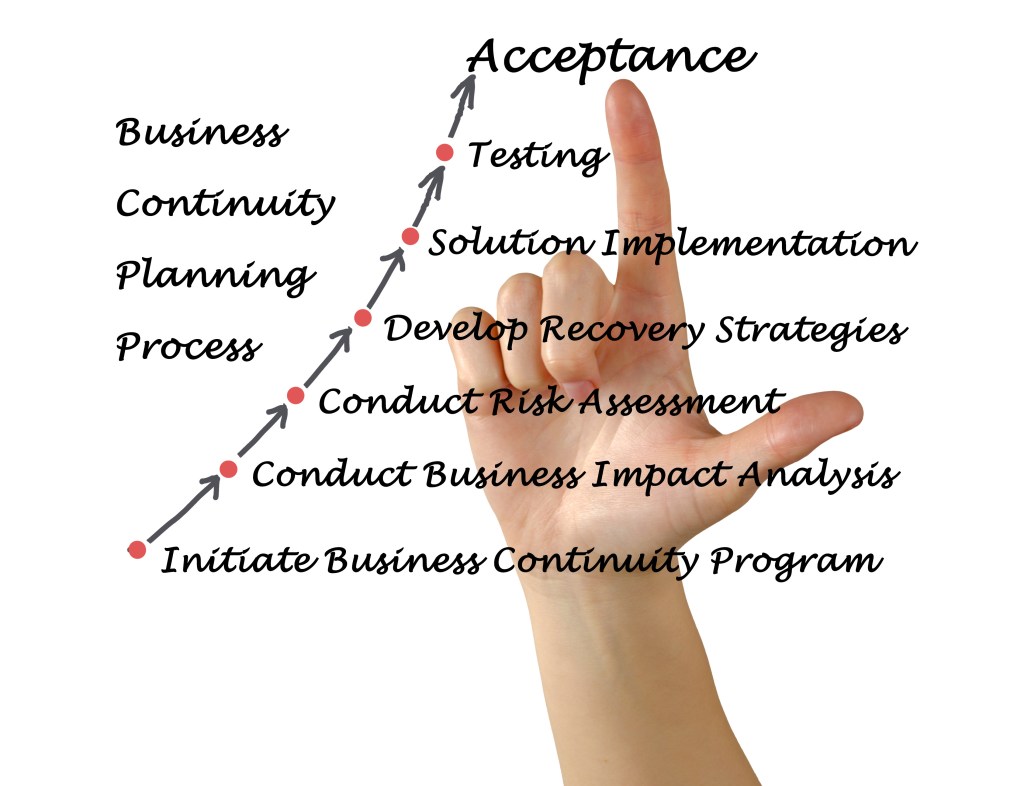
Include teleworking in business continuity planning

Finally, the Agreement addresses some of the lessons learned by employers during the sudden move to teleworking “en masse” in March 2019 and particularly the need for employers to review their business continuity plans where these exist or create such plans if not to cover teleworking as a result of exceptional/unforeseen circumstances/cas de force majeur such as a pandemic.

With this in mind, the Agreement insists on including in any eventual work agreement or employer’s charter the following:

  • the conditions and means of resorting to teleworking in the event of exceptional circumstances/cas de force majeure
  • a mapping of teleworkable jobs” beforehand to ensure a swift implementation of teleworking in the event of cas de force majeure.

If no works agreement exists, the Works Council (CSE) must be consulted concerning the measures planned to ensure business continuity. And if no WC exists, it is recommended for employers to consult with employees before implementing any business continuity plan unilaterally.

In the event of an emergency requiring an employer to implement urgently teleworking en masse, as in the case of Covid19 in March 2020, on the basis of article L.1222-11 of the French Labor Code, an employer can decide unilaterally to switch some or all employees to teleworking and consult the WC (CSE) as soon as possibly subsequently. The rule of mutually agreed teleworking does not apply. However, the employer must inform employees by whatever means possible and in writing if possible.

Otherwise, the rules applying to teleworking during exceptional circumstances are the same as the rules for teleworking in normal circumstances mentioned above.

One important point to highlight: in the event of teleworking due to exceptional circumstances, employees can now use their own equipment if the employer has not had time to provide any. Concerning Labor relations in exceptional circumstance resulting in significant teleworking, the Agreement recommends implementing a protocole between the social partners to clarify the operational rules with regard to mandatory WC meetings and consultations so that flexibility can be introduced with regard to mandatory consultations and to allow for WC meetings by visio.

Commenting afterwards, one of the employers’ representatives, M. Hubert Mongon of the MEDEF expressed satisfaction at the Agreement whcih he considered as operational and pragmatic. If the trade unions that signed were more muted in their praise, all expressed satisfaction at the much needed clarification to teleworking practices both in normal and in more exceptional/cas de force majeure circumstances.

A pragmatic step in the right direction bringing much needed clarity to the teleworking jungle!

Footnote: the French Ministry of Labor has formally authorized as of 7 January 2021 employees currently teleworking 100% to return to site work one day a week if circumstances permit and if their employers agree.

See below the French version of the Interprofessional Agreement.

ANI Télétravail – 26 11 2020 (courriercadres.com)http://courriercadres.com/wp-content/uploads/2020/11/ani-teletravail-26-11-2020.pdf

French Labor Ministry Covid19 Employers’ Protocol updated 6 January 2021

https://travail-emploi.gouv.fr/IMG/pdf/protocole-national-sante-securite-en-entreprise.pdf

Virtual presentations: some tips to help you get your message across.

November 15, 2020

As the Covid 19 pandemic continues across the globe, more and more countries are returning to a lock down similar to the lock down of March 2020 and remote working is becoming more and more the new norm. As a result, more and more employees are finding themselves having to make more and more virtual presentations on virtual meeting platforms like Teams, Go to meeting, Webex, Zoom, Google meetings, to name but a few. Indeed, even when the pandemic ends, which it will very soon hopefully, remote working seems to be here to stay and mastering virtual presentations will be a key skill for many, just like making physical presentations to audiences was a key skill prior to C19.

Virtual presentations can indeed be quite challenging even for an experienced presenter. Many more employees are suddenly finding themselves having to make virtual presentations without the experience of having already delivered presentations in classic meetings. And of course, with virtual meetings, remote audiences have more opportunities to stray, removed as they are from their “normative” office environment and now located remotely where everyone is vulnerable to a whole host of different distractions and interruptions.

Focus on the goal of the virtual meeting and not the potential obstacles.

Having organized, presented, participated in numerous virtual meetings over the years, having read through a lot of literature on the subject and having learned the hard way, here are some of my tips for making these virtual presentations work for you. What is most important is to remember to focus on the meeting goal and not on the possible obstacles and I hope the following tips will help prevent the most common glitches.

1.Check your technology beforehand

Lots of things can of course go wrong and often do go wrong: you’re locked out of the meeting room, your microphone or your camera doesn’t work, you’re not familiar with the meeting room control interface, you don’t have the meeting code, your network is down or slow, etc.

Take time to prepare.
Check your technology before each virtual meeting.

To avoid some of these issues, do a check of your technology before the meeting. If possible, do a dry run with a colleague or family member, just to check that your system works and you are able to familiarize yourself with the meeting room environment. But remember, it’s never that complicated and generally speaking, most, if not all, problems can be resolved quickly, if you give yourself the time beforehand.

Don’t wait until the meeting starts to discover a problem you won’t have time to fix, especially under pressure. Get technical support if necessary from your IT department or colleagues. But don’t wait until the meeting to discover the problem.

2. Choose your virtual meeting background

We may be lucky and enjoy a remote environment already set up for virtual meetings: well lit, spacious, neutral walls. However, most of us working from home may find it difficult to find a neutral space for our virtual meetings. Book cases, plants, family photos, ornaments, decorations, furniture, cabinets, wardrobes, paintings, heirlooms, etc. can all get in the way and cause unnecessary distractions for your audience.

Try to choose a setting that reflects neutrality and professionalism and doesn’t distract from the message you want to get across. Choose as neutral a background as possible. Alternatively, choose a virtual background or blur your background if the meeting application allows it. It’s always advisable to choose a location free from as much external distractions (traffic, neighbours, machines, music, etc.) as possible and always remember to invite participants to mute their phones and speakers until they want to speak in the meeting.

3. Pay attention to your lighting

Pay attention to lighting

Many of us have sat through virtual meetings looking at a darkened screen as the presenter at the other end does his/her best to capture and keep our attention. Rememeber to pay attention to lighting. Let natural light in if that is possible so you can be clearly seen. If you are in a box room or space without access to natural light, invest in a lamp that can light up your face. Put some light if you want your participants to “see the light”.

4. Practise your presentation beforehand

Take some time to rehearse your virtual presentation beforehand

As for any presentation, “practise makes perfect” and this is all the more true when delivering a virtual presentation to numerous participants spread remotely. Even if you can see them on your screen, it is always difficult to evaluate their engagement and attention compared to a physical presentation when everyone is in the same room. During the course of your virtual presentation, many potential distractions may pop up: participants disconnecting and reconnecting, traffic noises, police sirens, dogs barking, children playing, neighbours chatting, machines running, etc. and these are all potential distractors for both you and your audience.

So the more you prepare, the less you will be vulnerable to these distractions during the course of your presentation, whenever one or more suddenly intervenes in the middle of an important point. As the saying goes, “Fail to prepare, prepare to fail“.

5) Keep your message short and simple

Keep your presentation as simple as possible

Virtual meetings require a great deal of focus and concentration. So it’s important to keep the meetings as short as possible and to keep your presentation as short as possible. Keep the message simple. Keep your visuals as simple as possible centred on some key messages. Break your message up into sections and invite participation every ten minutes or so by asking for questions. Address participants by their first name. A break in your presentation can be a time to review and reply to the comments raised on the chat. Better still, have a colleague/participant track the chats and summarize them for you so that you are not distracted during your presentation.

6) Present to the camera, not to the computer screen

In a normal physical presentation, good presenters talk to the audience and not to the powerpoint or paperboard. It’s even more important to do so when you are delivering a virtual presentation. We have all sat through virtual meetings where the presenter is staring down from above or too far away from the camera, has a double chin or we are looking up their nostrils.

Try to look at the PC Camera
and not at the screen

The best way to talk to your audience in a virtual meeting to capture their attention is to look at the camera rather than your screen. This will help you maintain eye contact and hold the attention of your audience. It’s not easy to look at the camera and this takes practice but it helps to capture and keep the attention of your audience. Position your computer so that the camera is at eye level at it frames your face, neck and shoulders. Practice your positioning so that you are close enough to the camera but not too close. You don’t want to be too far away or alternatively your face is staring into the screen.

Remember, when you are testing your computer set up, pay attention to how you look and the positioning of your camera and you will avoid most of the above pitfalls.

7) Present Standing up if possible. If not, sit up straight

Pay attention to your posture.

If you can, use a standing desk or position your computer so that you can stand an eye level with your computer. Standing up is always better because it increases our energy levels, puts us in presentation mode and help keep the attention of our audience.

If you can’t stand up, sit square in a good solid chair with feet planted on the floor at eye level to camera. Slouching over your screen or leaning backwards will disengage your audience and distract from your message and of course lead to possible back problems later on.

8) Follow some virtual meeting etiquette ground rules

Virtual meetings require more focus and attention than ordinary office meetings. If you are participating in a meeting either as presenter or participant, set yourself some etiquette ground rules to help keep and maintain concentration of all participants.

  • Work from a dedicated space and not from your sofa or kitchen.
  • Don’t multitask during virtual meetings, avoid reading your emails, preparing another meeting or presentation. Turn off your email alerts and mute your mobile phone. Remain present and focused on the meeting at hand. Be present.
  • Don’t jump straight to the agenda: Allow participants a few minutes to reconnect with one another by exchanging small talk. If you are leading the presentation, ask team members how they are and how things are going. Start with a participant who is the most junior or who doesn’t speak so much and move around the table. Share how you are doing as well to set the tone.
  • Follow up your meeting: don’t forget to send out to all participants a summary of what was discussed and agreed either by email or other internal platform.
  • Be on time, follow the agenda and don’t overrun: show up on time, especially if you are the presenter. Follow the agenda and end the meeting on time. Virtual meetings require much more discipline than physical meetings.
  • Don’t systematically ask participants to mute their microphones: the general rule seems to be to ask participants to mute their microphones unless they want to speak. This is understandable in meetings that have large numbers of participants. However, in small meetings, it is perhaps better not to mute so that any participant can speak when he/or she wants. This also means that participants have to give their undivided attention to the meeting instead of multitasking when muted.
  • Dress for the job: It’s not because the meeting is virtual that you should negelect your appearance. Indeed, audiences are more attentive to appearance when they are looking at you on a screen. Pay attention to your appearance, grooming and dress for the part. It will make you feel positive and reinforce your message.
  • Use a headset: if you don’t mute, use a headset which allows you to take notes with pen and paper and excludes background noise.
  • No eating or drinking: we have all been at meetings where we or others arrive with cups of coffees and/or snacks. This is of course is not advisable when you are in a virtual meeting with twenty other persons. Save eating for afterwards.
  • Spread your virtual meetings: try not to have back-to-back virtual meetings as you deprive yourself of time to prepare. Schedule them during periods that fall during work hours. Remember to take into account time differences for international teams.
  • Show you are present: If you are not presenting and if you arrive late and someone is speaking, wait until the person finishes and announce your presence. Participants joining without announcing themselves is always unsettling for any presenter. Speak up from time to time. Ask questions. Make comments. Point out some key points. Help the presenter out. Make your presence felt.

9) Have a plan B in case of a technical problem

You have done all the testing and your system worked 5 minutes before the meeting. But Murphy’s law kicks in and you can’t get access to your virtual meeting room and have to connect up by phone. What about your presentation? Thankfully, foresight led you to share your slide deck with a participants before the meeting. Always have a Plan B which allows you to use the dial in option.

10) Engage your audience as if they are in the same room

When making a presentation physically, we usually bring lots of energy to capture the attention of the audience. We look at the audience, make some jokes, gesticulate, move perhaps around the podium. This all helps to engage the audience but becomes more challenging when delivering virtually, especially if the presentation is being delivered sitting at a desk over the internet.

But all the more reason to be energetic and to deliver the presentation at a good pace. Speak clearly and do your best to adapt your speed to your audience. Don’t use slang or coloquialisms, especially if you are delivering to an international audience, with different nationalities whose mother tingue is not the language of the presentation. Above all, enjoy the experience. The more you enjoy it, the more you will engage with your audience.

Hope the above tips help to make your virtual meetings more effective, more risk free and above all more enjoyable. Happy virtual meetings.

Some tips to help make “remote working” work for you

October 12, 2020

Due to the ongoing Covid19 pandemic, more and more employees are being asked by their employers to work from home. The longer the pandemic lasts, the more home office/remote working is becoming the “new normal” way of working. However, while home office/remote working has many avantages, it also has many pitfalls, especially for new remote workers.

Remote working can indeed represent quite a challenge for those workers who have rarely if ever worked from home and represents even a challenge for those more experienced remote workers who before the pandemic relied on office workers to support them.

Many new remote workers may not have been ready to transform a bedroom, garage, kitchen or unused corner of living space into a work space. Not to mention the sudden need to show up for video conference calls with background noises from spouses, kids, neighbours, traffic, etc.

If that is the case, here are hopefully some useful tips to make “remote working” work for you.

1. CREATE A DEDICATED WORK SPACE

All the remote working experts agree that the first thing to do is create a dedicated work space for yourself, however small. It is much easier to stay mentally focused if you have a specific area set aside for work, offering privacy and which you don’t have to recreate every time.

Once you sit down in your dedicated work space, you know it is time to work and when you get up, you have finished or you are having a break. As video conferencing is becoming more and more prevalent, try to have a background that you are happy to show others or if this is not possible, use the company video conferencing tool functionalities to provide a virtual background. If you are not comfortable with video conférences, don’t use a camera. Don’t forget to protect your privacy. Your home is your home first before it is your office.

2. Create a comfortable (but not too comfortable) environment

Try to create as comfortable a work space as possible, but not too comfortable. Avoid the sofas, rocking chairs, beds, couches, etc. that won’t help you focus. You will need a table and good ergonomic chair, a computer, printer and of course high speed internet access. Your employer should provide you with the basic tools needed to get your work done remotely. Many companies are now paying a “remote workers’ allowance to help subsidize remote office workers. Your manager of course should be attentive to your needs and help you get yourself set up. Make sure you have good lighting and if possible access to natural light. Surround yourself with some plants, paintings, decorations to help you stay positive during the course of the day.

Concerning how to dress, while it could be tempting to abandon dress code and personal grooming, to be most productive, dress for work because that is what you are doing. Don’t neglect your persona grooming for teh same reasons. Wearing work clothes will put you in productive mode immediately and help you focus on the day ahead. And when you have finished your day, change into casual clothes. It will help you keep a good separation between home life and work life.

3. Plan your day and week

Plan your day and week and write things down
Use the Eisenhower matrix to prioritize:
1)Do 2) Plan 3) Delegate 4) Eliminate

As the Roman Statesmen Seneca said, “no wind is favorable to he who knows not where he is going” and planning your daily and weekly work is even more important for remote workers. Working remotely means you have less immediate access to your manager, co-workers and organization and this makes managing priorities even more important. To know where you are going, plan your day and week and ensure your Outlook calendar is updated, including the back office tasks you normally do without necessarily putting in your schedule. Build a to-do list and update it regularly. Write things down to help you remember what you need to do urgently and what you need to plan. Share your calendar with your manager and colleagues so that they know what you are working on.

4. Build a routine

Build and maintain a daily routine as if you are in the office

To keep your motivation, treat your week the same way as if you were in the office. Start and finish at about the same time, have lunch at the same time. If you start earlier or finish later, take time off the next day to compensate. Try to keep the same rituals you had when you worked in your office. The closer you are to your office routine, the more comfortable you will feel. Once you have prioritized your work to fit around your routine, set aside the same periods for tackling the important and urgent tasks. Organize your team meetings and video conférences/telephone calls in batches, preferably in the afternoon so that you can have more free time to do analysis or work on presentations, preferably in the morning. Good Routines are powerful in helping you get things done in an effective and timely manner.

5. Act decisively

In an office context, when an issue arises, it is always easier to go to speak to a person directly to find a solution. In a remote context, this is more difficult. When any such issues arise, you should be ready to respond immediately. If you think there is a misunderstanding, pick up the phone and call your colleague, rather than rely on emails. As remote workers are even more acutely aware of time when working remote, return emails, calls and voice mails quickly. If you can’t provide the required answer immediately, discuss a deadline for doing so with the requester. Co-workers and your manager will be reassured that you are working on their requests.

6. Build in breaks in your daily routine

Working longer is not necessarily smarter
Use a Pomodoro Timer to break big tasks down into manageable smaller tasks achievable in 25 minutes and then take a break

Without the presence of co-workers and the often pleasant interruptions that come with office life, when remote working, it is easy to fall into the trap of losing track of time. Faced with a myriad of emails from co-workers and customers looking for immediate responses, it is even easier to want to try to reply to all the urgent messages immediately and remain glued to one’s computer screen all day long. Taking breaks becomes even more critical to help you maintain a better work-life balance. Know your company policy on remote working and taking breaks and apply it. If you have big tasks to perform, divide each talk into smaller, more manageable ones. Try out the Pomodoro technique to help you focus on specific tasks. Divide the day up into segments and try to work in short bursts of 25 minutes before taking a short break. The Pomodoro technique helps you keep fresh and helps you be more productive by managing your time and work more effectively.

7. Set aside time for physical and creative activities

All work and no play makes Jack and Jill a dull boy and girl. Set aside time for some physical or creative activities. If possible, go out for a walk or run. Use the garden if you have one for some exercise. Work out. Start a hobby. Do something that will help you discover new avenues of interest, get you away from the computer for a while and keep you mentally fresh. And C19 confirment rules permitting, if your remote office is becoming a bit stuffy, go outside to a café or a library if possible for a while.

8. Managers: adapt your management to meet the needs of your remote workers

Working remote is not the same obviously as working on site and requires particular management skills and effort. Remote working brings new and different challenges for managers who need to understand and take on board the specific needs of their remote workers.

The lack of face-to-face interaction may lead some supervisors to worry that their employees are not working as hard or as efficient. Many employees, on the other hand, struggle with the reduced access to management support and communication. In some instances, employees may feel managers are out of touch and neither supportive or helpful in getting their work done.

What’s more, working remote quite often requires more effort and longer lead times as vital information required in the decision making process is no longer immediately available to remote workers. And of course, without the ties that were being reinforced constantly through day-to-day physical interaction in an office environment, tensions may arise between team members who no longer have the context to interpret certain replies, comments and/or reactions of co-workers. Maintaining team cohesion and focus requires considerable effort and as a remote manager, you should do several key things:

Trust your team members working remotely. Focus on results and not activities.
  • establish regular check-ins with team members by phone or video. These can be on a daily basis if necessary, less frequent if the employee is more independent or team calls if the work is highly collaborative. What is important is that the calls should be regular and predictable and take place in a trusting environment so that team members know they can consult with you and that their concerns are heard and understood.
  • Don’t rely only on emails. Email alone is not enough. Vary the means of communication. Of course, video conferencing tools such as Team, Zoom, Skype are very useful, especially for sensitive subjects where face to face discussions are important. But even a quick telephone call can be beneficial and appreciated by the employee.
  • Clarify remote working rules of engagement: above all, as a manager, you should clarify the rules of engagement and set expectations for the frequency, means and ideal timing of communications for team members.
    • Agree with team members when and how team meetings take place, how the team will share information and how often
    • Share the bigger picture: keep the team updated with the overall goals. Review short term goals frequently and adjust if necessary.
    • Set clear expectations and trust your team to perform. Focus on results and not activity and avoid micro managing.
    • Ensure your team members have the tools to do their job remotely
    • Inform team members when they can contact you if they need to and agree with them how and when you can contact your them.
    • Set clear limits as to when they should be available for work together. Meetings outside office hours should be exceptions to the rule. Allow also for lunch breaks.
    • You should pay attention to communication between team members to ensure they are sharing information as required and be ready to step in if necessary to ensure all information is shared effectively within the team.
    • Remember to allow for some spontaneous social interaction between co-workers before virtual meetings and even organize virtual office parties if possible. That five minute exchange before a meeting is really important for team members and not just small talk.
    • Finally, you should be even more ready to offer encouragement and emotional support to remote workers who may be struggling to adapt to remote working. Check up on your team membres regularly, check how they are managing remote working and discuss ways of improving the situation. Remain mindful that your team members expect support in dealing with the new way of working and you shouldn’t take for granted the transition from office to remote working.

9. Remote workers: check in regularly with your co-workers AND MANAGER

As a remote worker, rememeber to keep in contact with your fellow co-workers and management. Besides the frequent team video conferences, take time to call a colleague just to check up on how he/she is doing. If you normally check in with the dept. assistant before starting work at the office, do the same when working remote. Don’t forget to acknowledge emails and voice mails and if you can’t reply immediately, let people know you will get back to them. Remember to “show up” in all team meetings, chats, emails by asking questions, sharing what your working on and enquiring about what collagues are working on. Even a simple hello and goodbye is ok. “Showing up” will help you stay in conversation and keep you on the team radar.

10. Communicate, Communicate, Communicate

Finally, because you are not in the office where people can see and talk to you when they want, communication is even more important when working remotely. Seek out regular feedback from your boss and colleagues. Show up for all meetings and video conferences. Keep everyone updated as much as possible on what you are working on and if you need help, don’t hesitate to speak to your manager and/or colleagues. If you are not sure whether your colleagues should be informed, inform them anyway as “more is better than less” when remote working. Again, set aside some time each day to contact a colleague or co-worker and just chat about things in general. If you are new to remote working, ask for feedback from more experienced employees on how things are going and how you can improve and be more effective.

trust circle hand drawn on whiteboard

This is indeed a very stressful time for everyone. As the Covid pandemic stretches on, remote working seems here to stay and what seemed yesterday a work organization reserved for sales people and software developers is now becoming a way of working for whole organizations.

So it’s important to step back and keep an eye on the bigger picture, have fun and if you are new to remote working, go easy on yourself. It takes time to switch over from a full office environment to a remote working environment and in many cases, organizations will be focusing on a mix between remote work and office work. The challenge will be for managers and co-workers to work together around shared remote working rules but as recent months have shown, the tools now exist to enable this to happen. But it is above all people that will not only make it happen but sustain it effectively if the above pitfalls are skillfully avoided. The key ingredient for effective remote working is “trust”. Avoiding micro managing, managing for results and not around activities will be the critical attitude for managers to adopt.

So happy remote working.

But please remember, whether you are working remote part-time or full-time, keep up the good work and keep applying the social distancing rules and especially:

  • wash your hands frequently
  • Use hydro-alcoholic gel
  • Above all, wear a mask when you are outdoors, if you share an office or when you are moving around in your office.

We’re all in this together and things will work out if we all follow the same simple rules.

Keep safe, keep well, Keep going!

Business Transformation: Key “hard factors” that influence success!

June 21, 2016

I wrote in a previous post about why many change management initiative fail and made some suggestions as to what to do to swing the balance in favor of success.

If according to research, many transformation initiatives fail, operationally and from experience, I know that many do indeed succeed!

Reflecting on all the good practices I witnessed over the years at different organizations that contributed to transformation success, I started thinking about how to summarize all those best practices in a short post and in doing so, I came across an article first published in the HBR in 2005 on the subject and entitled « The Hard Side of Change Management » by Harold Sirkin, Perry Keenan and Alan Jackson (see HBR The Hard Side of Change Management).

In this article, the authors highlight some key « hard factors » that must be taken into account if change is to be managed successfully and I thought it useful to review the authors ideas here as a pragmatic way of summarizing many of the good practices I have used or come across in the past and that have helped me achieve success in the transformation projects I managed or was associated with in recent years.

Indeed, in their article, Sirkin et al. focus only on the “hard factors” contributing to change management success because in their opinion, if “Soft” issues are important for success, managing these aspects alone isn’t sufficient to implement transformation projects. For them, “Soft” factors don’t directly influence the outcomes of many change programs”.

The Best Way To Predict The Future Is To Create It sign on desert roadFor Sirkin et al, we should focus first on the “hard factors” because as they say, “if companies don’t pay attention to the “hard issues” first, transformation programs will break down before the soft elements come into play”. Whether you agree our not, it seems to me obvious that it is indeed critical to be alert to the importance of these hard factors as a “sine qua non” for leading change successfully.

Hard factors have three distinct characteristics:

  • First, companies are able to measure them in direct or indirect ways.
  • Second, companies can easily communicate their importance, both within and outside organizations.
  • Third, businesses are capable of influencing those elements quickly.

On the basis of research they performed on a panel of 225 companies, the authors established a consistent correlation between the outcomes of change programs and four specific hard factors:

  1. Duration
  2. Integrity
  3. Commitment
  4. Effort

They called these variables the DICE variables as they “could load them in favor of project success”.

The way organizations combine these four factors creates a continuum – from projects that are set up to succeed to those that are set up to fail. Let’s look at those four factors briefly and the different success drivers that these four factors generate if organizations focus sufficiently on them before project launch.

1.Duration

We are all anxious for projects that take too long to implement and we have all felt the pressure placed on trying to complete projects rapidly, the assumption being that the longer the project goes on, the more likely it is to fail.

Lots of reasons are given: possible loss of momentum, the window of opportunity may close, objectives may be forgotten, key supporters may leave, problems may accumulate. These indeed are very real risks and very good reasons for moving fast.

However, according to the authors’ research, a long project reviewed frequently is more likely to succeed than a short project that isn’t reviewed frequently and it really is the case of “Hurrying slowly”!

What is critical for project success indeed is not project life span but in fact the time between reviews!

What does this mean in terms of actionable success drivers?

D1: Companies must set formal project milestones reviews with clearly definedDemingkreis deliverables for each milestone and the project cannot move on to the next milestone if all the deliverables for that milestone have not been met.

If this is the case, the project team must work with the project sponsor to understand why, take the necessary corrective actions and learn from the experience to prevent problems from recurring later on.

D2: These milestone reviews must be formal meetings and the project team must provide in advance to the project review team (that includes the sponsor) a concise report of its progress and evidence that the deliverables have been met. Reviews should happen at least every 8 weeks and even more frequently for critical projects.

D3: Sponsors and project teams must have authority to address any issues blocking progress and must be empowered to take corrective actions, add extra or different resources or suggest a new direction.

So at least 3 key drivers that act on project duration in a positive way.

2.Integrity

By performance integrity is meant the extent to which companies can rely on teams of managers, supervisors and staff to execute change projects successfully. Execution of course is key.

Change management projects are particularly complex and challenging and of course require highly skilled project leaders and team members capable of executing the plan.

Often, companies either don’t have enough “star performers” or senior managers don’t want to sacrifice their “stars” to change projects because they fear regular work will suffer. But success depends on allocating the best talent to the project and companies have to convince senior managers to free up their stars. So what can we do?

D4: Companies must accept to free up their “stars” while making sure that day-to-day operations don’t falter.

D5: Change initiatives need to be well led. Managing change means dealing with a wide range of activities, resources, pressures, unforeseen events and ensuring team cohesion

Initiative Definition Button Showing Leadership Resourcefulness And Action

and meeting deadlines. This means choosing carefully not only a “star performer” but that “star” must have the right project management skills.

Senior management must therefore choose carefully the project leader and the key members of the project team and a precondition for successful selection is defining in advance and publishing the criteria by which candidates will be evaluated.

Good project leaders should have the following skills:

  • Excellent problem solving skills
  • Results focused
  • Methodical while tolerating ambiguity
  • Possess organizational savvy
  • Accept accountability for decisions
  • Be highly motivated and self starting
  • Possess humility and not crave the limelight

D6: The project sponsor should take personal responsibility for selecting candidates based on these criteria and the senior executive team should agree the candidate selected. Senior managers demonstrate their commitment to the project by involving themselves directly in the recruitment of the project manager and team members.

I have often seen CEOs and senior executives become very involved in the recruitment process and each time, it has had a strong impact on project success.

Do What Is Right Not What Is Easy card with sky backgroundD7: Project leaders and key team members should have a clear mandate and this should be defined in a project mission statement and their objectives of course should be included in the annual appraisal process. Roles and responsibilities should be clear, expectations and deliverables should be clear and shared within the organization as quite often, the project will cut across organizational and functional responsibilities and therefore potential for conflict and resistance to change.

D8: Of course, it is not enough to recruit and appoint your project team. Companies must reward and recognize project leaders and teams when the project is successfully completed and ensure that the success feeds into the career management process of all concerned so that taking on the role of project leader is seen as a stepping stone to success and encourages “star performers” to see the role as one that will further their careers and not as a burden.

So at least 5 actionable drivers that impact positively on Performance Integrity and on project execution.

3.Commitment

For Sirkin et al., companies need to obtain the commitment of two different groups of people if they want their change projects to take root:

  • the most influential executives (not necessarily the top titles)
  • The grass roots: people who must deal with the new systems, processes or ways of working.

D9: Concerning influential executives, senior managers must be seen to “walk the talk” and even when the senior managers feel they are doing so, quite often, this is not perceived so by the grass roots. So senior managers must communicate again, again and again and do three times as much as they would think is necessary.

Of course, senior managers must not only support the project but they must constantly explain the “Why” of the proposed change. There can be very many good reasons why senior managers don’t want to do this but it is always vital to communicate clearly on the reason for change and what it means for employees. So Communicate the “Why” constantly and it is always better to communicate too much than not enough.

Having said that, problems are often caused by inconsistent or confusing or contradictory messages coming from management and especially in tense situations, employees perceive these confusing messages as indicative of something hidden.

D10: So a lot of effort must be dedicated to preparing and sharing the communication with

Change Management Strategy

top and middle managers so that management from top to bottom can speak with one voice and align their messages so that one consistent message is delivered throughout the organization.

The authors stress that companies often underestimate the importance of middle managers and staff in driving change and often postpone communicating with them until very late. Delaying communication can create confusion and even alienate staff and so it is always vital to communicate early and involve middle managers and key staff.

D11: Companies should seek the support of middle managers and key staff by communicating early to them on the “Why” of the change and ensure the same message is understood and shared by all.

Finally, organizations often underestimate their ability to build staff support. Reaching out to staff can in fact turn them into change champions.

D12: Don’t hesitate to reach out to key staff early in the project if you want to offer them the chance to become change champions. Quite often, even if the change requires sacrifices and even los of jobs, staff can react positively if the changes are presented clearly and they are given a chance to voice their concerns.

So at least 4 key drivers that impact on the Commitment of middle managers and staff in a positive way.

4.Effort

One important aspect too frequently neglected by organizations is that staff are already busy with their day to day tasks and if they are have to deal not only with their daily work but also with changes to systems or processes or tools, they will quite often not be able to cope and resistance to change ensues.

So an important effort must be made by project teams to calculate the extra work beyond existing responsibilities to introduce the change. The authors offer a figure of 10% as being an acceptable limit but of course this is only a guideline.

D13: Project leadership must be conscious of the impact of the extra work on staff, calculate the extra workload and limit the extra work to no more than10%.

Time management diagram

However, for employees already fully-loaded, companies must decide whether to take away some of the regular work from key employees participating in the transformation project or rid them of the discretionary or non-essential tasks. 

D14: Senior management should ensure key employees can offload unnecessary or non-essential tasks. This can be done by outsourcing non-essential tasks, bringing in interims or even postponing or cancelling such tasks.

In addition, companies can also review all the projects in the operating plan and assess which ones are critical for the transformation. This can mean delaying or rescheduling some projects to free up stars and key resources to focus on priority projects. If this happens, senior management should be mindful to explain clearly to the project teams impacted on the reasons for the change so that they remain committed and motivated.

D15: Senior management must be ready to look again at all the projects in the plan, reprioritize according to the critical impact of each project and reallocate key resources to the most critical projects if necessary.

So at least 3 actionable drivers that impact positively employee work load.

The authors go on to outline how they created a scoring system based on these 4 factors and that allows managers to predict the chances of project success.

This scoring system allows managers to categorize projects into one of three categories:

  • Win (the project statistically seem likely to succeed)
  • Worry (the project’s outcome is hard to predict)
  • Woe (the project outcome is totally unpredictable or fated for mediocrity or failure.

We won’t discuss here the details of the DICE scoring system. However, the authors tell us that the DICE Framework and scoring system has been used by the Boston Consulting Group to predict the outcomes and guide the execution of more than 1000 projects worldwide and they indicate three key advantages that I think are important in building the foundations of change management success:

  • Track projects: A scoring framework (DICE or any other) provides executives with an early warning system of potential problems in a transformation project because it gets senior management to review each project according to these four criteria and evaluate how effectively it has “allocated people, senior management time and other resources” to each project. As soon as a project shows poor scores, senior management is obligated to intervene and take the necessary steps to put the project back on course. It seems to me vital to build in to the change management process such an early warning system because it is always better to prevent than to cure and it’s no good closing the stable door if the horse has already bolted!!
  • Manage portfolio of projects: large transformation programs can often contain many different projects and if the portfolio of projects is not managed well, these tasks can end up competing for attention and resources. By deploying the DICE framework (or a similar framework) from the outset, senior management can identify problem projects in the portfolio, focus execution expertise and senior management attention where it is most needed rather than allow certain projects capture all the resources. In other words, senior executives can set certain critical projects up for success and work on the less critical projects in the “Worry” zone progressively to get them into the “Win” zone. Indeed, as the authors point out, “when companies are trying to overhaul themselves, they shouldn’t have all their projects in the Win zone. If they do, they are not ambitious enough and transformations should entail fundamental changes that stretch the organization.
  • Force Conversations: The authors point out that it is already difficult to get consensus from senior managers on what factors contribute most to ensuring transformation success and this applies even in an organization using the DICE Framework or some other similar way of predicting the outcomes of a transformation project. The real value of DICE is that it provides senior managers with a common framework to debate questions such as “Why do we see the project in different ways?” and “What can we agree to do to ensure the project will succeed?” Simply put, DICE provides senior managers with a common language and forces the right discussions to take place.

D16: So it seems to me important to define and implement a project portfolio scoring system (DICE or a similar system) that allows senior management to predict project success proactively as well as build a consensus through strong discussions on what actions are required to optimize the chances of those projects in the “Worry” or “Woe” zones.

These are some very practical and actionable items that lay the foundations for change management success because not only do they ensure the main building blocks are in place but also because they contribute to helping senior management and project transformation teams have the necessary discussions that help them predict success rather than simply focusing on what went wrong.

It could be said that these drivers don’t necessarily guarantee success. In my view, they may not guarantee success but success is certainly inhibited if they are not implemented at project launch.

In my view, it is clear that every transformation project needs to be founded on “hard factors” that include:

  • A strong senior management sponsor that communicates constantly on the reason and goals of the change project.
  • A competent, results focused project manager.
  • A competent, motivated and engaged team.
  • Reward and recognition for successful projects teams.
  • Middle managers and staff that understand the reasons for change and have the opportunity to participate in the decision making phase and not only in the execution phase.
  • A project schedule, milestones and defined deliverables at each milestone.
  • A formal review for each milestone by senior executives.
  • Project managers empowered to take corrective action when things go wrong.
  • A limit on the extra work expected of key players who have the possibility to offload or even postpone unnecessary tasks.
  • A “project success predictability” scoring system (DICE or other such system) that forces discussions amongst senior management on how to predict future success (rather than focusing on what went wrong) and on what actions to take to manage projects from “Woe” to “Worry” to “Win”.

And as JFK once said,“all of this doesn’t happen, it has to be made to happen”.

make it happen text write on paper

What do you think?

Why Change Initiatives fail and what we can do about it.

June 6, 2016

According to a study back in 2013 by Towers Watson, only 25% of change initiatives are successful in the long term! (See Victor Lipman, Forbes, Why Change Management Fails)

Quite dismal results when you think of the huge investment made by many corporations to implement change initiatives in their organizations, even more so when you consider that such initiatives are almost always announced as critical for future business success!

Highlights of the study involving approx. 280 large and middle size organizations from North America, Europe and Asia showed that:

  • Employers felt 55% of change management initiatives met initial objectives but only 25% felt gains were sustained over time
  • 87% of respondents trained their managers to manage change but only 22% felt the training was effective.
  • 68% of senior managers said they got the message for change but this fell to 53% for middle managers and 40% for front-line supervisors.


These are quite dispiriting figures and seem to show, unsurprisingly, that the lower down you go in the organization, the less informed and therefore less engaged employees are.

Why do these change initiatives fail? More importantly, what can we do about it?

Commentators suggest the following reasons why change initiatives fail:

  • The change initiative goals are not realistically attainable
  • The CEO is not at the forefront of driving the change
  • Senior managers talk the talk but don’t walk the talk.
  • Middle managers and supervisors are not sufficiently informed and don’t really understand the reasons why the changes are needed
  • Management wants a quick fix and doesn’t understand that implementing change is a long-term effort.

These are certainly very understandable reasons and the following solutions would seem the very least we should do:

  • Look at the territory and not the map. Set SMART change objectives.
  • Make sure the CEO is at the forefront and leads the way!
  • Make sure senior managers not only talk the talk but walk the talk by demonstrating the behaviors required to drive the change down into the organization
  • Prepare for the long term. Lead, plan and budget accordingly.

But what about the crew down in the hold rowing hard to the corporate drum beat?

Doing all the things listed above will certainly increase our chances of getting more buy in from grassroots employees but what more can we do?

How can we get grass roots employees to engage more directly and more often in supporting and implementing enduring and sustainable change? How can we harness the power of the grass roots employees to deliver extraordinary results long-term?

This is really the question at the heart of “The Open Organization, Igniting Passion and Performance”, Jim Whitehurst’s account of his leadership journey when he became CEO of Red Hat, a world leader in open source solutions.

open orgThe starting point of Jim’s leadership journey was his realization that the traditional top down, command and control, classical hierarchical organization that he was used to at Delta Airlines could not work for the Open Source culture of Red Hat.

For Jim joined an “Open Organization”, an organization that is not led in the traditional top-down way and that depends on ever-growing collaboration between internal and external communities of contributors who update and improve software (essentially Linux based) by working together, an organization where decisions are taken not top down but bottom up or even from edge to edge of the organization to respond to business opportunities. If Linux is open source and supposedly free, Red Hat is in the business of adding value to free code and providing customers with peace of mind that “their entire system based on Linux is the most stable and secure system on the planet”. And to do that, openness, transparency, participation and cooperation inside and outside the organization is critical.

Moreover, as Jim explains, not only do they need the inputs of more and more employees

Think Outside The Box Tic Tac Toe Concept

further and further away from the centre or from partners and customers if they are to innovate and gain competitive advantage but decisions have to be taken faster and faster. For such organizations, the traditional hierarchical chain of command no longer works because it takes too long, consumes too many resources and because they don’t own the code on which their solutions are based. As he says himself, “you can’t command initiative, creativity or passion”. These are gifts and every day, employees choose whether to bring them to work or leave them at home. Suppliers and customers likewise.

So leading such an Open Organization requires a new management paradigm where decision-making is no longer the prerogative of hierarchy and where decision making is top down but one where decision making is bottom up, where employees are trusted to do the right thing and where management is hands off enough to allow the people in the organization to direct them and make their own decisions.
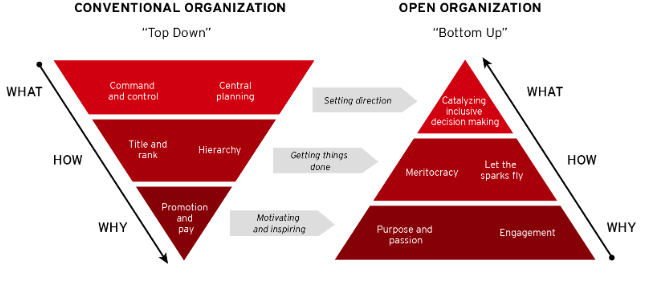
open org management model


I would highlight 7 key leadership principles that are key to managing change successfully in Open Organizations and indeed in all 21st century High Tech, innovative organizations.

  1. Start with Why!

For Jim Whitehurst, you must start with “Why” because starting with “Why” and building a compelling sense of Purpose creates an extraordinary degree of engagement among all stakeholders and catalyzes creativity, innovation and organizational commitment. Jim Whitehurst quotes Whole Foods CEO John Mackey and Babson College Professor Raj Sisodia:

PURPOSE concept

“People are most fulfilled and happiest when their work is aligned with their own inner passions. Personal passion, corporate purpose and business performance all go together”. If you can create a compelling reason for people to participate, they will.

So a compelling Purpose is the first driver of engagement and if your change initiative doesn’t have a clear compelling Purpose that employees identify with, you won’t get the levels of engagement from employees required to drive change successfully.


  1. Ignite Passion!

But a compelling Purpose is not enough. Today’s workers want their work to mean something and they want to be part of something that makes a difference. So organizations must activate passion amongst employees to really achieve great performance.

An employee who feels passionately about his company’s purpose will be engaged and

Wherever you go, go with all your heart

motivated to deliver extraordinary performance and go that extra mile. And to get that passion, organizations must be prepared to challenge their people to take initiatives, find ways to innovate and of working together to gain an edge on the competition. As Jim Whitehurst says, if you don’t want passionate people, you can always use robots but robots won’t deliver innovative solutions to unforeseen or new complex challenges!

So the second ingredient in managing change: encourage passion in your employees and give them opportunities to express their passion from Day 1!

  1. Engage your employees from Day One!

As employees today need to understand “Why”, leaders need to engage with their workforce in a much more direct, continuous and positive way. Expecting employees to behave proactively and assume accountability for their decisions means that leaders have to provide much more information and context than ever before and this means much more than simply pushing information down the organization through the usual internal communication channels.

This means constant and ongoing dialogue between leaders and employees at all levels. So in an Open Organization, the leadership role is not undermined or abandoned. Rather, the leader’s role becomes one where he/she constantly provides context and meaning and constantly supports employees in their decision making by “determining the appropriate amount of latitude that each individual is capable of handling, plus develops, coaches and stretches their capabilities along the way”.

This third element of successful change management requires leaders to engage constantly with employees and not only when some change management initiative needs to be implemented. If leaders haven’t been busy building the engagement of their team members from day one, don’t expect to get it when you need to launch an urgent organizational change. It’s too late!!!

  1. Develop Accountability!

In conventional, top-down command and control organizations, Accountability is simple. I am accountable to my boss who is accountable to his/her boss who in turn is accountable to his boss, etc. But as Jim Whitehurst points out, real Accountability is not asking permission to do something or saying “May I” all the time.

It’s about being accountable for a set of outputs after the fact! And if you want employees to accept real accountability, you need to foster a culture that encourages initiative, trust, transparency, information sharing and all the things that allow employees to feel that they have the means and the support from leaders to take reasonable decisions at their level and are willing to be therefore accountable for the results.
 

AccountabilityAbove all, the best way for leaders to develop Accountability is to demonstrate it themselves and walk the talk by actively seeking feedback from all levels of the organization on whatever issues concern team members. Leaders have to listen to and engage with employees on how to resolve the issues raised rather than simply telling them to shut up or accuse them of being obstructionist. One very frequently used way of getting feedback is the annual employee survey and one equally important way of walking the talk is by acting on the employee feedback obtained in the annual survey in a positive way.

As Jim Whitehurst says, feedback is a gift so take the feedback at face value, don’t shoot the messenger or risk disengaging your employees!

It’s all about trust. Employees who trust their managers are more productive and trust comes from open dialogue and from leaders walking the talk!

So real accountability is a 4th element in ensuring successful change management and again, this has to be from Day One and not only when circumstances require it.

  1. Enroll your thought leaders, not just your managers!

In classical top down organizations, decision-making is simple. The Boss decides ultimately and the hierarchy dictates who gets heard. In Open organizations like Red Hat, this can’t work.

Those closest to the issue rather than those responsible for overall direction of the organization or team, tend to make the decisions. This of course requires collaboration and mutual respect between employees and their managers in a complimentary relationship. Decisions are made on merit. In other words, they are made on the best case put forward and excellence, not position, prejudice, titles, politics or privilege is the criterion of choice.

So the role of leaders is to ensure decisions based on merit can be made by the right people working together on the right things. And how do leaders do this?

They can do this by building an organization that listens to all employees and allows Hand writing the text: Be a Voice Not An Echoeveryone to voice their opinions openly so that gradually, real thought leaders can rise to the top. Organizations of course usually know who their key influencers are (the thermostats as Jim Whitehurst calls them), those thought leaders within the organization who are generally recognized by their peers for their achievements and expertise and whose contribution is vital for the success of any change initiative. But such thought leaders are unlikely to contribute positively if they are being stifled by a command and control type manager or if they witness colleagues being gagged or not being listended to. If you want your thought leaders to participate willingly and if you want to avoid groupthink conformity, proactively encouraging a culture of open expression where everyone’s voice is heard is a (small) price to pay!

So to ensure the success of your change initiatives, listen to everyone from day one!

  1. Nurture creative abrasion!

It’s not enough to show you listen. In conventional organizations, everyone is expected to fall in line and conflict is seen as a threat and usually repressed. But as Jim says, you can’t get the best creativity, initiative or efforts from members of an Open Organization, indeed any organization, by saying “Go do this”. The best ideas happen when teams “hash things out”! Open organizations therefore encourage and accept not only bottom up feedback but also organize and develop strong, energetic internal debates which may even occasion conflict and opposing points of view.

What Jim Whitehouse calls “creative abrasion”, something that involves some level of conflict – a disagreement, contention or argument – works best when it is practiced in a community that has a shared purpose, shared values and rules of engagement that help keep the conflict productive rather than destructive”.

If you don’t encourage such debate, you may well end up with what Jim calls a “terminally nice” culture that ends up in real trouble because you never initiated the difficult conversations required to challenge the status quo and get the meaningful inputs required to turn things around.

And the role of leaders in these Open Organizations is even more important: encourage and manage these abrasively creative discussions where everyone is free to exchange their points of view in a candid, positive way. Jim quotes the former CEO of Xerox PARC who

Disrupt Change Innovate New Business Product Concept Word Collag

said: “you want an organization that argues with you. And so you want to nurture the bottom up but you’ve got to be careful that you don’t degenerate into chaos”. In a way, leaders have to disrupt the conventional way of getting things done if they want to avoid falling in to the “terminally nice” culture that suffocates successful change management!


Lots of tools now exist to orchestrate such internal debates and in implementing them, you can use the wisdom of the crowd to police discussions. Indeed, peers themselves will step in themselves if discussions become too virulent, if you really have a community of like-minded employees who share a common goal.

So 6th element in managing change, accept being challenged and proactively promote a creatively abrasive, bottom up feedback culture and do it from Day One!

  1. Involve employees directly in decision-making!

Managing change is fundamentally about decision-making and getting decisions implemented operationally. So change management is not only about big transformational projects but is at the heart of what leaders need to do every day: get their team members to adapt with agility to change and execute effectively.

In a typical command and control organization, the manager says and the employee does but we all know that it doesn’t work like that in real life, especially in Open Organizations, indeed in most 21st century high tech organizations. Leaders need the buy in of employees to execute effectively.

But as Jim Whitehurst points out, classical change management approaches usually focus on the “execution” phase and huge effort is spent on “explaining and selling the changes” top-down to employees, once decisions are made by management at the top.

At Red Hat, they do it differently. Rather than focus on “selling” the execution plan to employees once the plan is hatched, they have moved most of the change management activities into the decision-making process itself and using a host of different feedback mechanisms, get inputs from all levels in the organization before any significant decision is made or implemented. The drawbacks are numerous: the feedback process is time consuming, objectives needs to be explained and understood, leaders have to be prepared to listen and even ready to alter their plans according to the concerns raised and this can be threatening for many managers.

But as Jim Whitehurst points out, the results are worth the effort because the time you

pride acronym concept

lose in preparing your change is gained back in the adoption phase because you have more employees on board and they will follow you “because they trust you and not because you ordered them to”. As we all know, employees feel more ownership in the changes needed when they are involved in the decision behind them!

This doesn’t mean that a company is a democracy. leaders still remain the ultimate decision makers and may have to make difficult decisions despite all the efforts to listen and engage teams. But if you take the time to explain why and can back it up with a rationale, you can still drive progress and get things done.

So the 7TH element in managing change successfully is in switching the change management from the execution phase to the decision making phase and really making the effort to involve employees in the decision making process on an ongoing basis.

Hurry slowly. It’s worth it!

So 7 simple principles for leading change in Open Organizations.

And they obviously work for Red Hat as they have grown from an organization with revenues of $400 million to one with revenues of $1.5 billion. A great achievement.

But in my view, these 7 essential principles of leading an Open Organization can be applied in any organization, Open Source or otherwise, that seeks to foster initiative and creativity rather than running operations on HiPPO – the “highest paid person’s opinion”.

And if they are applied, they will help to build a really collaborative culture where employees are engaged from Day One and change doesn’t need to be “managed” but is an integral part of the leadership and collaborative team work process on a daily basis.

Remember the 7 Principles of leading in change in an Open Organizations:

  • Start with Why
  • Ignite Passion
  • Engage with your employees from Day One!
  • Develop Accountability at all levels
  • Enroll your thought leaders as well as your managers!
  • Nurture creative abrasive bottom up feedback
  • Involve employees proactively in the decision-making process


What do you think?

 

What’s killing Employee Engagement and how to deal with it?

May 23, 2016

JFK once said « Things do not happen, they are made to happen » and Mark Hurd, CEO of Oracle may have been thinking of JFK when he chose Employee Engagement as the topic for his address at the opening keynote session of Oracle HCM world in Chicago recently (see The Compelling Case for Employee Engagement).

Employee engagement deals of course with how deeply an employee connects with his/her company and how willing he/she is to « go the extra mile » to get the job done well.

make it happen text write on paperWhen employees are engaged, they think not just “what’s in it for me?” but “what’s in it for us?”.

Employee engagement is of course a “hot potato” for all organizations the world over as between 30% and 50% of employees declare themselves to be disengaged to greater or lesser degrees, depending on the Survey and the region.

So why did the CEO of a global High Tech company chose to handle such a “hot potato” in such a public way?

Engagement: a Productivity driver!

The reason is simple. Mark Hurd chose to discuss engagement, because he considers the topic as not just a noble gesture but a real « productivity » mechanism that contributes directly to the company’s bottom line. And Mark Hurd was ready to admit that increasing engagement from 70% to 80% at Oracle would deliver around 2 Billion USD in savings! That’s a huge impact!

«The team with the best help for their business model usually wins », Hurd continued and we all know that to win outside, you have to win inside. Of course, over the past few

Employee Engagement

years, due to the economic downturn, many companies have compensated for sluggish growth by cutting costs. But as Hurd reminded his audience, there is another way to cut expenses: “raise employees’ productivity and get more output for the same investment”. As Hurd said, “more highly engaged employees do more work, do better work, care more about your customers, they perform better and so does the whole entity”.

Not just a Millennial issue!

What’s more, it is not a generation thing with millennials being somehow more disengaged than Generation Xers or Baby Boomers. As Hurd pointed out, all generations seek more or less the same things, have more or less the same expectations and are more or less engaged.

So what drives Engagement?

So what do employees expect? What drives higher engagement and what can we do to influence these drivers positively?

Research on Employee Engagement identifies many key drivers of employee engagement. Below are a few of those key drivers and some suggestions on what we can do to live up to JFK’s words and make things really happen rather than wait for them to happen! Some of these actions may well be on the Oracle Engagement Action Plan!

1)Company Purpose

Not surprisingly, engagement is not only about money!

Today, employees want to be paid fairly but they also want to work towards a greater

Do work worth doing

purpose and to do work that really matters. At its core, a company’s purpose is a bold affirmation of its reason for being in business. It conveys what the organization stands for in historical, ethical, emotional and practical terms. No matter how it’s communicated to employees and customers, a company’s purpose is the driving force that enables a company to define its true brand and create its desired culture. Quite often however, companies don’t formulate their purpose very well and fail to communicate it from top to bottom of the organization.

More importantly, often, there may be a disconnect between the company’s Purpose and the behaviors demonstrated lower down in the organization. Action speaks louder than words and a bold company purpose has to be backed up by coherent behaviors within the organization. Not only Talk the talk. Walk the talk!

Some key suggestions:

  • Clearly formulate the Company Purpose and communicate it to the organization top down.
  • Start at the Top! Express the Purpose in terms of some key top-level business and management behaviors expected of senior leaders and encourage them to walk the talk!
  • Organizing round tables throughout the organization between managers and employees to define simple meaningful behaviors that express the Company Purpose at local level.
  • Include these behaviors in leadership and employee learning and development programs.
  • Build these behaviors into the annual appraisal process and indeed in the ongoing discussions between managers and employees.
  • Recognize and reward employees who demonstrate these behaviors in positive ways and share with the organization as a whole.


2) Company Strategy and Direction

If you don’t know where you are going, you may end up somewhere you don’t want to be and most research shows that employees need to have a clear appreciation of where the company is going and how their own actions are contributing to business results.

This means cascading strategy in a simple, pragmatic way and ensuring that employees’ operational objectives are connected to overall strategy.

Some key suggestions:

  • Make Employee Engagement a strategic objective and define the key KPIs to measure improvements to employee engagement. Hold managers and HR accountable for reaching Engagement targets and monitor on a regular basis.
  • Of course, use all the classical methods to share and update the company strategy: Annual Kick Offs, monthly All Hands, newsletters, intranet, etc.
  • Use the annual appraisal process as a tool to translate the strategy into actionable SMART goals at operational level and to ensure employees connect what they are doing to overall strategy and goals with the help of their managers.


3) Leadership

Employees don’t leave companies. They leave managers!

Most research shows a clear and critical link between an employee’s level of engagement

Leadership diagram

and his/her relationship with his/her manager. The better the relationship, the higher the engagement. Employees expect today a positive, mentoring type relationship with their managers and more importantly, expect more autonomy, more opportunity to express their opinions and contribute to decision making more frequently and directly.

Some key suggestions for leaders:

  • Today, employees expect to have a voice! Empower your team members. Explain the strategy and how it translates for your unit in operational terms, encourage your team members to propose their own objectives and discuss with them as and when these objectives need to be aligned.
  • Employees expect regular feedback so meet your team members regularly. Discuss whatever needs to be discussed and position yourself as a coach who wants to help team members achieve their goals. Be hard on the issues, not on the people.
  • Employees need to feel trusted so be transparent and share wherever possible information that helps them understand the business.
  • Delegate and control: delegate responsibility but always control and hold team members accountable. More empowerment means more accountability.
  • Lead by example and walk the talk.
  • Seek first to understand before being understood!
  • Invite your team members to offer solutions and you will find they will have a lot of ideas.
  • Promote a no-blame, continuous improvement approach. If team members can express opinions, admit mistakes and seek to improve, they will be more confident and engage more readily.
  • Say thanks regularly and not necessarily with money.


4) Relationship with peers

Most research suggests that a positive work atmosphere and good relationship with peers is critical to employee engagement.

The better and stronger these relationships are, the higher the level of engagement. And the best way to promote great relationships is to develop great teamwork!

Some key suggestions:

  • Ensure clarity of purpose – Employees must know what they are trying to accomplish, why, how well, and with what priorities and constraints both as a team and individually and where the two intersect.
  • Ensure clarity of roles – Talent and responsibilities must be well-matched so employees feel challenged but with a fair shot at excellence.
  • Ensure clarity of process – Employees must understand how the game is played, know where things stand, know how they can best contribute, believe decision-TEAM - Together We Can Manage, acronym business conceptmakers are informed and fair, and believe they can influence the process if things are going awry.
  • Recruit eagles and teach them to fly in formation! On boarding is critical and engage with new starters as of day One!
  • Use the annual performance review as a way of updating on roles and responsibilities and on monitoring skills required to do the job on an ongoing basis.
  • Encourage Cooperation and not Competition. Reward cooperation as much as possible because effective teamwork delivers exponential results above anything star performers can do!
  • Keep things simple and put people first.
  • Defend your team in times of trouble. It’s a great way to build trust. All for one and one for all! When things go wrong, examine first the process and see how the team can improve together.


5) Continuous Improvement

Research consistently shows that engaged employees not only want to do a great job today but want to improve continuously and expect their organization to promote a continuous improvement culture.

One concrete way of promoting a continuous improvement mindset is by constantly seeking employee feedback and involving employees not only in identifying the problems but also in offering the solutions.

Some key suggestions:

  • Promote a culture positive to feedback. Deploy an annual survey of course but don’t wait for the once in the year audit results to find out what employees think. Seek feedback frequently and multiply the channels for obtaining feedback.
  • Feedback is a gift. Engaged employees want to contribute and care about what they are doing so accept the feedback, however critical it may seem. Don’t seek to punish or reprimand and don’t prejudge why employees respond the way they do. Take the feedback as it is.
  • Involve managers, team members and HR not only in analyzing the results but also in defining the action plans together so that all parties are part of the solution not the problem.
  • Recognize and reward teams for continuous improvement suggestions that are implemented successfully and share throughout the organization.


6) Career development

Engaged employees have high expectations with regard to how their careers are being developed and want to believe they can grow with the organization.

Some key suggestions:

  • Use the Annual Performance Appraisal as a Career Plan for each employee and to discuss strengths and development needs, roles and responsibilities, how to stretch the employee in his/her current role, what roles the employee can target as a career step and what skills are needed to succeed the move. Set loose career goals with each employee and discuss progress year on year.
  • Promote a learning and development culture. The annual performance review is the best place to set some SMART learning objectives for each team member to help him/her progress on his/her career plan.
  • Learning doesn’t only need to be classroom based and can also involve coaching, new assignments and responsibilities, special projects, etc.


7) Compensation & Benefits

Most research shows that employees expect to be treated fairly compared to their

Equity theory business diagram illustration

colleagues in terms of compensation and benefits and expect decisions concerning compensation and benefits to be taken as objectively as possible.

However, research also suggests that while compensation is a contributing factor in employee disengagement, it is rarely a critical factor, especially when it comes to deciding whether to go or stay!

Some key suggestions:

  • Be transparent on the process. Explain the rules upfront to all employees concerning how compensation & benefits plans are built, how salary increases and bonus awards are decided, by whom and with whom, when and where and give employees the opportunity to share their expectations early with their managers before decisions are finalized.
  • Train managers of course in the fundamentals of Comp & Ben and how to discuss with employees the salary review process.
  • Promote a “Total Compensation” approach which highlights all the different components of the employee’s compensation and not just base and variable.
  • Don’t forget other Benefits because Base pay is not everything and research often shows that employees are ready to forego a raise for a good perk such as a health plan or retirement plan! Research also shows that for most employees, pay and benefits do not pay a significant role in decisions to change job. Culture and values, career opportunities and senior leadership have a more direct impact on employee satisfaction and therefore on employee retention! Food for thought.

So lots to do and great challenges indeed to reinforce employee engagement from a leadership and organizational point of view.

Of course, employees have their own part to play in developing their engagement levels and we’ll discuss in a later blog.

Like the painting of the Eiffel Tower, it’s a never-ending battle but one that is worth the effort and investment!

What do you think?