What makes a Great Team? How to go from Good to Great!

May 7, 2016


So Leicester City has won the English Premier League!

If you are not an avid soccer or sports fan, this piece of news will probably leave you cold.

But for all the crazy sports fanatics around the Globe, this is a truly astonishing result.

Here is a team that has absolutely no recognized « A » players in its first team, has one of the smallest budgets in the Premier League, that was almost relegated to the lower league last year, has a manager who had never before won anything and that was given 5000/1 odds to win the League at the start of the championship!

Yet, Leicester managed to beat some of the richest teams in Europe, all staffed with high profile “A” players. A victory indeed for the underdog!

leicester

Leicester City: Soccer Scrum Champions?

So how did the 5000/1 underdogs do it? They undoubtedly had good players at the start of the season but how did they go from Good to Great?

Of course, there are many reasons but one key reason has got to be great teamwork!


And what are some of the success factors that contributed to achieving this great teamwork?

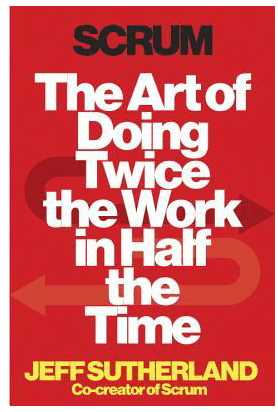
I guess Jeff Sutherland, the father of “Agile Management” and co-creator of the “Scrum Software Development Framework” would probably have some more very interesting ideas on this subject.


This is the question he sets out to answer in

Capture d’écran 2016-05-06 à 11.37.01

Why do some teams achieve greatness when  other teams languish in mediocrity?

Indeed, after some years of working in various senior management positions managing software development projects, Sutherland came to two very simple conclusions:

  • The traditional command and control « Waterfall » method of software development where projects were completed in distinct stages and moved step by step towards ultimate release to consumers and software users just didn’t work. Projects were often late, overran on budget and quite often were even abandoned because they no longer corresponded to the customer’s needs.
  • Worse, from a people point of view, this traditional “Waterfall” approach was a nightmare for those who had to apply it, made life miserable for all and more or less encouraged mediocrity, poor teamwork and failure.

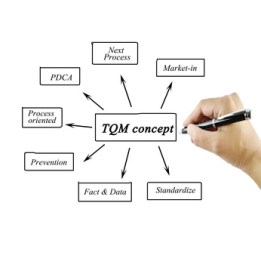
Inspired by the Toyota Total Quality System (TQM) in automotive manufacturing,

Women hand writing element of TQM concept.for business concept and use in manufacturing

Sutherland gradually came to define an alternative way of managing software development projects, which he called “Scrum” and which has become globally recognized as one of the most effective way of developing software projects.

How does Scrum work?

To simplify, rather than trying to implement the inefficient “Waterfall method”, whenever you start a project, you regularly check in with your team members, see if what you’re doing is going in the right direction and if it’s actually what people want. And at the same time check if there are ways to improve how you are doing what you are doing and if there are any ways of doing it better and faster and what obstacles may be getting in your way. Simple really!

This dynamic process follows a few simple steps:

  • Build an initial plan and rough cost estimate good enough to start;Concept of Scrum Development Life cycle and Agile Methodology, Each change go through different phases and Release
  • Gather a small, competent and empowered and cross-functional team to execute;
  • Prioritize the work around the initial tasks that will deliver some value very quickly for the customer and use demos to show to all at the end of each work cycle;
  • Organize the teamwork around short work cycles of 2 to 4 weeks called Sprints;
  • At the end of the Sprint, check what has been done, what remains to be done, what was done well, what can be improved and move on to the next cycle.


But what has Scrum and Software Development to do with the success of our 5000/1 Leicester City sporting underdogs?


For Scrum to work, it involves not only a whole new way of working but more importantly, a whole new mindset to managing projects and teams.

As Jeff Sutherland says, Scrum is a simple idea but executing it requires thought, introspection, honesty and discipline and Leicester City certainly showed all of these qualities throughout the season.

But when we look closer at some of the Success Factors behind Scrum which help teams go from Good to Great, I would highlight at least 7 key success factors I suspect helped Leicester City transform themselves from Good to Great.


1. Great teams have a goal but build the road as they go!

Scrum teaches us that while it is important to have a clear idea of the final objective, great teams build the road as they go and it is better to refine the plan throughout the project rather than do it all up front. You can never plan everything up front. The real world doesn’t work like that. People don’t work like that.

Plan in just enough detail to deliver the next increment in value and estimate the rest of the project in large chunks. This of course means having confidence in the team to work closely together as they go so that the plan is constantly adapted to the changing environment and customer needs.

Key takeaway: Promote an agile organization that doesn’t over obsess with Gantt charts and exhaustive planning and accepts that what seems like a bad decision now is better than a decision delayed taken too late. Progress slowly towards the goal, Sprint after Sprint, match after match!


2. Great teams plan and prioritize…just enough!

If Jeff Sutherland reminds us of the trap of trying to plan exhaustively everything that has to be done before acting, he never suggests that we should work in an ad hoc way.

If you want to go fast, you nevertheless need to plan sufficiently to ensure you attack the key challenges that really add value for the customer.

For any software development program, as Jeff Sutherland points out, 80% of the value is delivered by 20% of the functionalities. So Scrum insists on defining that 20% of essential work that needs to be done, prioritizing that work in terms of value for the customer and then attacking those tasks delivering highest value first in the Scrum work cycle called a Sprint, usually of a duration of 2 to 4 weeks.

Sutherland reminds us of some simple quality tools that are very useful for planning and Demingkreisnotably, the Plan, Do, Check, Act (PDCA) cycle created by Prof. W. Edwards Deming and
adopted by Toyota. This simple tool helps to plan and prioritize work from Sprint to Sprint so that you define what you want to do, you do it, you check what you have done, and you correct what you did not do or did wrong.

A simple but effective way of escaping the ad hoc, day-to-day execution of tasks!

Great teams plan simply and prioritize so that they deliver 80% of the results by doing the key 20% tasks first from cycle to cycle.

Key Takeaway: Train all employees in all functions to use continuous improvement tools such as PDCA and Pareto. It will help teams plan, do, check and act on the key 20% of tasks adding 80% of value. Above all, you will drive improvements everywhere.


3. Great teams focus on Systems! Hire Eagles and teach them to fly in formation!

All companies want to recruit the best person for any job but as Jeff Sutherland points out, modern business has perhaps become too focused on finding “A” players and star individuals when the real exponential value is generated through building effective systems which allow great teams to flourish.

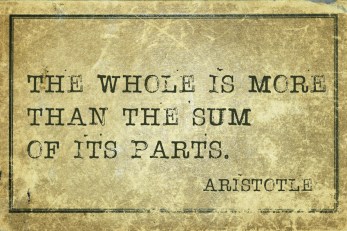
Scrum teaches us to focus above all on the System and not the person because an efficient system will always deliver exponentially more value. It is really a case of 1+1 = 3n rather than 1+1 =2. As Aristotle said more than 2000 years ago:

whole is more print

And Leicester City surely demonstrated this more than 2000 years later by putting the system first!

Key takeaway: Great teams focus on effective systems. Seek to develop and optimize high performance systems that allow great teams to flourish! Hire Eagles and teach them to fly in formation!


4. Great teams promote a no-blame culture!

If improving the system can deliver much more than blaming any one individual, it is important to understand this and promote a no-blame culture that encourages everyone to participate in perfecting the system.

As an example of why this is important, Jeff relates the case of General Motor’s NUMMI automotive plant in Fremont, California that was closed 1982 by GM who considered the workforce the worst in America.

When Toyota wanted to reopen the plant in 1984 with GM in a JV, GM recommended hiring the management but not the workforce!

Toyota did the exact opposite and rehired the workforce but not the management!

Very soon, NUMMI was producing cars with the same precision and as few defects as those made in Japan. As Sutherland says, same people, different system, different management methods, different outcomes!

NUMMI

This is what I like to think happened at Leicester City. They focused on the system just as Toyota did at NUMMI, forgot about the poor results of previous years and set about building a system that would eventually deliver outstanding success.

Key takeaway: rather than blame individuals, always promote a no-blame culture. Team members will be more ready to cooperate, participate proactively and contribute to improving the system. Blame the people and you sap the team spirit and morale, you tackle the wrong problem and you allow a failing system to continue. It’s as simple as that.


5. Great Teams build Trust

Trust is the glue that holds great teams together.

Diagram of trust

If you have a goal and you work to that goal and fight to continuously improve so that you can accelerate and deliver more, this means focusing on how to improve the process as you go.

This means team members must take responsibility for their own share of the work and how to improve it and they will only do so if they trust their team. Team members have to be able to give honest and straight feedback to one another that helps every one to improve and this will only happen in a climate of trust. If there is no trust, team members may adopt all sorts of deviant behavior such as hoarding information, ignoring errors, silo mentality, blaming others, all the behaviors that inevitably inhibit greatness.


6. Great teams share Purpose, Autonomy & Skills

To achieve team greatness, as Jeff Sutherland points out, all teams must have 3 key characteristics:

  • A higher sense of purpose which unites and motivates them to overcome difficulties and achieve success together
  • A sense of empowerment to take the decisions they need to take at their level to move fast. The more a team has to defer to an external authority to get things done, the less chance they have of success.
  • Finally, each team should have all the skills it needs within the team to deliver the expected results. The more a team has to defer to an external resource to get something done, the less likely it will succeed.

Key takeaway: Instill in the workforce a sense of higher purpose; Build a system that empowers them to act effectively towards that purpose and constantly track and provide the skills needed by that team to become Great.


7. Great teams seek to improve continuously!

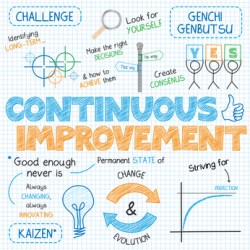
At the heart of Scrum and the Toyota Total Quality System is a constant quest for continuous improvement.CONTINUOUS IMPROVEMENT Vector Sketch Notes

Scrum encourages teams not only to ask what they have done but how they can improve on what they have done so that in the next work cycle or Sprint, they can go even faster.

Continuously improving the process accelerates the productivity from Sprint to Sprint so teams can work smarter without having to work harder!


Indeed, at the end of each Sprint, team members perform a ”Sprint Retrospective” where they look at:

  • What was done during the Sprint?
  • What went right?
  • What could have gone better?
  • What can be improved during the next Sprint?

These simple questions can be asked everywhere throughout any organization for any project or task.

This continuous improvement mindset must of course be shared by the whole organization, from top to bottom and not only those on any given project. If senior managers don’t believe this, employees lower down won’t either.

As everyone in the organization must not only “talk the talk” but “walk the talk”, this involves the company culture and values and everyone needs to understand and buy into this continuous improvement culture and values.

All employees can be educated to understand and adopt this mindset in many ways: from on boarding, to the annual objective setting process, to rewards and recognition, to work methods and processes, to internal communications, to training and development, to Succession Planning, even to the internal Annual Survey and the types of questions you ask, how you ask them and how you act on employee feedback.

And every function should have its own continuous improvement goals and agenda.

Key takeaway: Actively seek to promote a continuous improvement culture throughout the organization and train and educate employees at all levels to adopt a continuous improvement mindset that seeks not only to “do” but also to improve “how” to do.


To conclude, these 7 key success factors contribute to building Great teams:

  1. Have a goal but build the road as you go
  2. Plan and prioritize…just enough
  3. Focus on effective systems. Hire eagles and teach them to fly in formation!
  4. Build a no blame culture
  5. Promote Trust
  6. Develop Purpose, Autonomy and Skills
  7. Seek to improve continuously


Great teams of course do much more than this but you will have to read Scrum: The Art of doing Twice the Work in Half the Time to discover more “Success factors” on how to help teams go from Good to truly Great.


And well done to Leicester City who, like real champions, show us how the “Whole is so much greater than the sum of the parts” and that good players can become a Great Team when some Scrum success factors are added into the mix in a disciplined and honest way!


What do you think?


PS: I’m a Munster fan myself. That’s Rugby Scrum and not Soccer Scrum…but that’s another story!!!


Unveiling the Tesla Model 3 – Answering the question Why?

April 8, 2016

On March 31, 2016 last, Elon Musk unveiled the new Tesla model 3 and from a Leadership point of view, what is really compelling is the way he chose to  do it.

Rather than  trying to sell the Model 3 to his audience by  answering the question “What” and focusing in detail on the car’s technical specifications as a traditional car maker would have done, Elon Musk chose first to answer the question “Why” Tesla are doing what they are doing.

For Tesla is about much more than just making good cars. Tesla has indeed a much more compelling mission which is expressed through 2 key goals:

  1. Accelerate the transition to sustainable transport by building an affordable and attractive 100% electric car;
  2. Save lives by building a car which emits no toxic gases. As Musk reminds his audience, 53000 people die each year in the US alone due to toxic gas emissions from combustion cars and Tesla are helping to attack this urgent public health issue in a direct and concrete way.

These are indeed compelling goals that speak to everyone and I am sure Elon Musk and his management team have no problem motivating their employees to engage with this compelling higher purpose which is so impactful on people’s lives and on the planet.

Indeed,  Elon Musk wastes no time reminding us that “it is really important to accelerate the transition to sustainable transport for the future of the world“, given the increase in CO2 levels and that it doesn’t make sense to continue to produce cars that emit poisonous gases!

So Tesla’s mission is  not simply to make cars. Tesla’s mission is to address these very TESLA LOGO
serious issues of climate warming due to excessive CO2 levels and alarming death rates due to car pollution by making cars that are good for the climate and safe for people. By buying a Tesla electric car, customers are of course not simply buying a car but they are also saving the planet and saving lives. What a powerful mission statement!

These are fantastic and great reasons for buying a Tesla and certainly much more compelling than the traditional arguments used by the established car makers! What’s more, any fears future Tesla users may harbor linked to battery range or recharge times are significantly reduced when compared with the idea that buying a Tesla will save lives and save the Planet.

Elon Musk also reminds us that Tesla started off as a small team with few resources and this adds to the sense of a highly united band of pioneers who have beaten the odds through a clever strategy of starting out small and building gradually towards the final objective of producing the first great 100% high volume, affordable electric car. This is a very convincing argument for all the early adopters who want to participate in a truly great  endeavor that goes beyond simply buying a product.

And of course, Tesla is disrupting the car industry and forcing the traditional car makers to  play catch up. As Musk says, Tesla is breaking the mould and car makers like Chevrolet and Nissan have since launched similar programs in pursuit of Tesla, even though Tesla has not been producing high volumes up to now. Small in volume but big in impact! David is beating Goliath!

Elon Musk remembers to thank his customers for buying the initial  Tesla models: the Roadster, Model S and Model X and these initial customers have provided the resources to fund the design and development of the Model 3. So Tesla users are not simply customers but are above all pioneering champions who are helping to make the Tesla dream a reality and by doing so, help solve very serious global  issues. Really powerful reasons for switching to Tesla!

Musk suggests future Tesla customers needn’t worry about order availability because the factory in Fremont has huge spare capacity to meet increased demand, having produced 500 thousand + cars in the past!

Concerning batteries, the Tesla Giga factory being built is the biggest such factory in the world where more lithium ion batteries will be produced than in all the other factories in the world combined!! Astonishing!

maxresdefault

Tesla Giga Factory will produce more Lithium Ion batteries than all other factories combined worldwide!

Finally, Musk describes the key features such as acceleration speed, range, autopilot hardware, interior space, head room, leg room, cargo room, interior roominess, etc using simple words that speak to all. You can even fit a  7ft surf board inside! How different to the traditional technical vocabulary quite often used by traditional car makers.

And of course, the Tesla service network is growing fast and the Tesla network of supercharging and destination charging points will increase significantly by end 2017 when the first Tesla Model 3 will be delivered, guaranteeing customers the freedom to go wherever they want to go.

For Musk, cars are about Freedom and that is indeed a very contrarian message when you think how cars in recent years have become synonymous with traffic jams, gridlock, pollution and illness and to such an extent that they are increasingly being locked out of most large urban centres.

So the dream is becoming reality and Tesla is showing that it is possible to produce a great electric car despite all the obstacles from a technology, industrial, consumer, infrastructure, ecological point of view.

An extraordinary and fascinating example of how to drive change, disrupt a seemingly inertia ridden, highly conservative industry and indeed transform an every-day object that is seen as expensive, dangerous, technical, dirty, highly constraining,  etc. into one which is attractive, easy to use, simple, beautiful, exciting, user-friendly and delivers freedom.

And the 300,000 + customers who have ordered a model 3 since the unveil representing more than 11 billion USD in future sales would certainly seem to agree.

Brilliant! Fascinating vision! Putting the passion back in manufacturing. A great example of how visionaries like Elon Musk are helping to widen the cone of innovation and disrupting industries which up to now have seemed impervious to change!

Go Tesla!


A Contrarian’s view to start-up success -from Zero to One by Peter Thiel

March 3, 2016

It could seem quite contrarian indeed  to question generally accepted conventional wisdom that competition is synonymous with capitalism. Ever since Adam Smith, we have been educated to believe that free competition is the foundation of economic prosperity and every entrepreneur should willingly and gladly accept that competing for market share is the rule of the game.

Nor would you expect such a contrarian point of view to come from someone who studied at Stanford law school before going on to co-create a successful start-up like Paypal before selling it off to eBay for 1.2 Billion USD.

But this is what Peter Thiel precisely does in his very provocative and contrarian minded book “Zero to One: notes on startups or how to build the futurethielbinb. In his presentation to the Chicago Ideas week in 2015 on the subject of entrepreneurship,   he touches of some of the key ideas and themes that run through “Zero to One…“. In his speech below, he underlines three key points that he believes entrepreneurs should bear in mind which are nevertheless contrary to conventional wisdom on how to get a startup to succeed.
1. Aim for a monopoly in a niche market to escape competition!

To succeed, businesses need to be unique and so differentiated from their competitors that they are no longer even competing. Why? Because as Peter Thiel points out, a world of perfect competition “competes away” all profits. The more companies compete over the same finite piece of cake, the less cake there is, the more their profits are squeezed and the less cash flow they have, the less they can invest in long term growth. Successful start ups create their own market through discovering and growing a unique value proposition and executing fast before any possible competition has time to react. In other words, they escape the competition trap by creating a monopoly in a niche market!


Peter Thiel cites Google as a good example of a company which has managed to “escape the competition trap” by acquiring more or less a monopoly of the internet search market thereby guaranteeing itself huge cash flows for years to come. Happy companies like Google found a way to radically differentiate themselves from the competition early and escape the competition trap. Unhappy companies however are all alike because they failed to escape the essential sameness of competition. So the goal for any start up is to build a technology or a solution or an answer to a market need that is so unique that it allows the startup to escape from this competition trap. As Peter Thiel provocatively asserts,  “competition is for losers”.

2. Find a secret that nobody else can see!

For Thiel, the “cone of progress” has become too narrow and technological innovation seems to have been restricted to the IT space in the last decade or so. The IT space will continue to innovate but there are other realms which are worthy of exploration, such as bio-tech and space. We seem to have stopped exploring  these other realms for many reasons but we need to seek out the secrets that these areas are hiding. Secrets are unique opportunities that others don’t see. There are still many secrets to be discovered in the world of medicine, space exploration, bio-technology and it takes effort, dedication, hard work and investment to uncover the secrets these realms still contain. Above all, whether it is iT or bio-tech, to succeed, we  need to see a unique problem nobody else has tried to solve and solve it rather than simply compete with others in the same market.

3. Globalize horizontally  and innovate vertically!

Finally, Peter Thiel distinguishes between Globalization on the one hand and Technological innovation on the other and while he believes we must do both, he asserts that we must make a careful distinction between Globalization on the one hand and Technological Innovation on the other. For Thiel, Globalization means spreading existing technology horizontally on a massive scale. He cites China as an example of horizontal growth where the Chinese are copying on a large scale technologies invented elsewhere in order to close the gap as fast as possible with the developed world. This we need to continue to do of course.

On the other hand, Technological Innovation or vertical innovation as he calls it brings new and radically different step changes in existing technologies and this technological innovation can only be achieved through focusing on widening the cone of progress beyond IT into other neglected realms of technological exploration.

As Peter Thiel says, we need to “develop the developed world” because the very idea of a “developed” world implies that we no longer need to progress. If so, we will gradually slip into a state of sclerosis. So the good news is that there are still new frontiers to be discovered and conquered in medicine, space, aeronautics, science,..and Thiel invites all would be entrepreneurs to seek out the secret path and unique idea that will set them on the way to success, with a lot of hard work, risk and investment of course.

In “Zero to One”, it is worth recalling  7 core questions Thiel says all businesses should answer before launching any new venture:

  1. The Engineering Question: can you create breakthrough technology instead of incremental improvements?
  2. The Timing Question: is now the right time to start your business?
  3. The Monopoly Question: are you starting with a big share of a small market?
  4. The People Question: do you have the right team?
  5. The Distribution Question: Do you have a way not just to create but to deliver your product?
  6. The Durability Question: will your market position be defensible in 10 and 20 years into the future?
  7. The Secret Question: Have you identified a unique opportunity that others don’t see?


Very hard questions of course. Very contrarian and provocative and food for thought for all entrepreneurs big and small!

Enjoy “Zero to One”, a great overview of the forces driving innovation in  the IT sector and why we need to widen the cone of progress if we want to launch a new age of entrepreneurialship. Elon Musk is showing the way!

JN


The Power of Purpose

February 22, 2016

Check out this very enjoyable and thought-provoking speech by Robert E. Quinn from the Ross Business School at the University of Michigan  in which Robert reveals very simply how we can all bring positive change around us. The secret lies in discovering our sense of a higher purpose!

As Robert Quinn explains, “when we embrace a sense of a higher purpose, meaning increases in our lives. When we increase meaning in our lives, we increase our sense of empowerment. When we feel more empowered, we take more actions and when we take more actions, our positivity goes up.

Increased positivity allows us to see things in new ways, make new associations, build more positive, enriching  relationships around us. More enriching relationships helps free up untapped potential. When we have sense of a higher purpose, we are willing to step out of our comfort zone and do things we didn’t want to do before, take those difficult decisions and face those conflicts we avoided before”. Empowering!

Managing paradoxes – The Competing Values leadership framework

January 31, 2016

Organizations today are more and more complex and it is very challenging indeed for managers to understand how to deal with this complexity in an effective way. Quite often, managers are torn between what would seem to be “competing” and even “conflicting” requests pulling them in opposite directions simultaneously. At the same time, their surroundings seem more and more complex, inhibiting effective action. They understand that simplicity is required but such simplicity would seem hard to reach.

The “Competing Values” leadership Framework, first conceived at the University of Michigan business school is a very simple leadership model which provides managers and team members alike with a very simple and coherent tool, allowing all  to “see” through the apparent complexity of their organizations to the underlying simplicity driving their business, thereby offering an insight into the apparently contradictory but inevitably positive and complimentary  tensions and constraints acting on them, tensions that can be harnessed to work effectively and positively in a constructive way.

How does the “Competing Values” leadership Framework work?

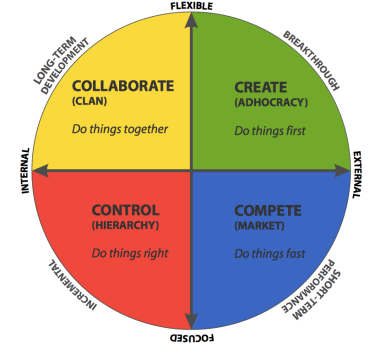
As Jeff deGraff explains in the Video below, the “Competing Values” model looks at two positive tensions found in all organizations:

Tension 1: On a vertical axis, there is a necessary tension between the organization/person seeking “flexibility” and the organization/person seeking “stability“;

Tension 2: On a horizontal axis, there is a necessary  tension between the “internally facing” organization/person and the “externally” facing organization/person.

Capture d’écran 2016-01-31 à 17.02.28

These two positive tensions create 4 specific profiles  that occur at the individual level, the organizational level and of course at the outcome level.

  • Profile 1: the “Create” profile. In the top right quadrant, the “Create” profile seeks high flexibility and is focused on the external world. When we think of this profile, we think of the person who likes to “do things first“, the “innovator“, “pioneer“, “inventor“, the “artist“, the “visionary“. Steve Jobs would be a good example of this “Create” profile. The upside of this profile is that he/she is most likely to come up with the right solution. The downside, there is a lot of risk involved. Organizations with a “Create” profile run high risk and rely on radical innovation to progress quickly. All will remember the ad campaign run by Apple which even had as a banner “Here’s to the Crazy Ones” which illustrates the “rebel” nature of the “Create” profile.

  • Profile 2: The “Control” profile. Opposite in the bottom left quadrant, is the internal, stability focused profile. This profile seeks to “do things right” through robust processes, procedures and lots of metrics. This is a profile operating in a highly complex environment requiring large amounts of data with a lot of scalability where risk and failure is not an option (engineers, surgeons, doctors, pilots,…). Such organizations seek incremental innovation with little risk and seek to avoid radical transformation at all costs.

The interplay of these two profiles “Create versus Control” creates a tension around innovation and “how much” innovation a company needs.

  • Profile 3: The “Competitor” profile. In the bottom right quadrant, we have the individuals/organizations that are “externally and stability” focused and who seek to “do things fast“. These profiles are strongly goal oriented and seek to win “at all costs“. These profiles are focused very short-term. The down-side of this group is that they are not very good at building sustainability because their sole concern is “winning the game today“.
  • Profile 4: The “Collaborator” profile. In the top left quadrant is the Collaborator profile who is inwardly and flexibility focused, who wants to do “things together that last” and is held together by very strong values that he/she is trying to instill in the organizations he/she serves. These profiles are great at building “sustainable, long-term” organizations but they don’t always move so fast (relatively speaking) as they are focused on relationship building which necessarily takes time.

The interplay of these two opposing profiles “Competitor versus Collaborator” creates a second tension in any organization concerning “How fast the organization should innovate”. Do we go really fast to obtain the short-term goals or do we go a little less fast so that we can develop the culture and competencies that will make the organization more sustainable in the long term?

Jeff deGraff reminds us that there are 3 key points to be remembered when applying the “Competing Values” framework to any organization:

  1. Any organization is only as good as the “weakest” quadrant. To develop, grow and succeed, you need all 4 quadrants to play an integral part. For example, if we are great at the “Create” quadrant but not great at the “Control” quadrant, we won’t be able to take that radical new idea and turn it into a really big idea that will work everywhere because we won’t be systematic enough. So all 4 quadrants are necessary and they have to work in sync.
  2. We must build a management “portfolio” because one style of management won’t work everywhere. We may start a project in the “Compete” mode with a strongly goal focused project manager but at a certain moment in time, we may want to transition to a “cooperator” profile if we want to make the project sustainable in the long term.
  3. Most importantly, “how we create” is “what we create”. In other words, define your processes to the outcome you expect. If you want a radical new idea, select a “Create” profile and not a “Control” profile, pick the right kind of processes which encourage a “radical” outcome and don’t burden the project with excessive processes and procedures which will inhibit action and the generation of a radical outcome expected.

To summarize, as Jeff de Graff points out, rather than being counter productive and to be eliminated at all costs, the tensions generated by the interplay and competition of these four profiles : “Create versus Control” and “Compete versus Cooperate”  through “constructive conflict” can produce the hybrids and types of innovations today’s complex organizations are looking for.

Above all, as Jeff de Graff’s fellow academics Cameron and Quinn point out in their book entitled “Diagnosing and Changing Organizational Culture” (2011), “the highest-performing leaders…have developed capabilities and skills that allow them to succeed in each of the four quadrants. That is, they are self-contradictory, behaviorally complex leaders in the sense that they can be simultaneously hard and soft, entrepreneurial and controlled….Managerial effectiveness is inherently tied to paradoxical attributes, just as organizational effectiveness is. Effective managers and effective organizations are paradoxical! 

Food for thought!

Check out  Jeff de Graff’s website for more information on the Competing Values framework at Competing Values Leadership


Autonomy, Mastery and Purpose: 3 keys to driving higher performance

January 16, 2016

Why organizations need to rethink their carrot and stick approach if they want to motivate employees to deliver higher performance.

The “carrot and stick” approach is a tried and trusted classical way of rewarding performance in business organizations. Paying someone more for reaching specific objectives is generally considered as a simple way of driving the behaviors an organization needs to get the results it requires to satisfy customers and share holders. Money is considered to be the key driver of employee motivation and most organizations have some form of “carrot and stick” policy whereby they reward good performers with bonues and ignore poor performers (or worse). This “carrot and stick” approach is indeed so classical that most organizations take it as self-evident and as “the only way” to recognize performance and motivate employees.


But what if this very simple and fairly universal way of driving performance is not as effective as it is generally thought to be? Not only that, what if the good old “carrot and stick” approach not only doesn’t deliver the good performance it is supposed to but in fact even drives poor performance, the very opposite of its intended purpose?


This is what Dan Pink asserts in a very thought-provoking presentation on the subject of Employee motivation and the factors that drive higher performance.

For Dan Pink, the basic and supposedly “self-evident” notion that you inevitably get the “behaviors you reward” needs to be challenged. He draws upon different studies made by experts at MIT on the link between monetary reward and increased performance which seem to demonstrate that increased monetary reward, rather than driving higher performance, produces in fact poorer performance. Briefly stated, MIT performed a series of tests with students where they rewarded the participants according to their performance in a series of academic and cognitive tests. The best performers would receive most financial reward, the worst performers would receive nothing.


Surprisingly, these tests reveal two startling results:


  • As long as the test involves purely mechanical skills, the higher the reward, the better the performance. In other words, the “carrot and stick” approach seems to work perfectly for mechanical, unimaginative tasks.


  • However, once the task calls for more than rudimentary cognitive skills, surprisingly, a larger financial reward led to poorer performance. The more the task requires conceptual and creative thinking, the less financial reward seems to drive performance.


This does not mean to say that money is not a motivator. However, money, as Maslow and Hertzberg amongst many other thinkers on human motivation have pointed out, usually only helps to reduce the impact of  “dissatisfaction” rather than increasing causes of satisfaction.


Paying someone more is simply a way of getting money off the table as an issue and removing it as a distraction.


However, paying someone more won’t necessarily get you better performance, particularly when it comes to knowledge workers.


So if money in organizational terms doesn’t make the world go round, what does?


Pink points to 3 key factors leading to better performance:


  • Autonomy


Back in the 80’s, Peter Drucker already pointed out that you can’t manage people the way they were managed in previous decades. The more educated the worker, the more he/she is driven by a desire to be self-directed. The old “command and control” management mindset cannot work with today’s generation of highly educated, technology biased, highly mobile, generation Y workforce. Today’s workforce needs to feel in command of its own destiny and self-direction is key. Command and control is great if you want compliance but not so great if you want engagement and today, all organizations know that it’s no longer enough to enforce compliance to get good performance. Engagement is the key and engagement cannot be commanded. It must be nurtured.


The key to higher performance today is employee engagement. Organizations need employees to engage, go the extra mile and you can’t force employees to engage and give the necessary discretionary effort upon which all success really depends today. The less self-directed an employee is in his  job, the less motivated he will be and the size of the carrot won’t change this. So for Dan Pink, the first challenge facing all organizations seeking to drive higher performance is to drive autonomy down into the organizations so that employees can direct their own activity aligned to the organizations goals.


People will no longer accept being told what to do. They can accept being told what goals need to be reached but they won’t accept being told how to achieve those goals. Empowerment is therefore critical to driving higher performance. Give people more autonomy, empower them to act and you increase the chances of ensuring they  deliver more.


Pink gives a very concrete example of how a company can seek to empower its workforce to be more productive through greater creativity and innovation. He mentions an Australian software company, Atlassian, which seeks to encourage the creativity and innovation of its employees, not through an “innovation bonus” but by allowing their software engineers once every quarter to work on what they want for a whole day. There is only one precondition: the software engineers then have to produce the results to the company in special workshops. Just one way management can get out of the way (if only for a day) and allow employees the autonomy to do what they want to do aligned to corporate objectives.


2) Mastery

A second factor driving performance is mastery. The more we feel we master an area of expertise, the more satisfied we are. This is why people take up different hobbies and try to develop expertise in all sorts of exotic areas. We all like to progress and grow and become better at something. More money won’t give us a feeling of mastery if our role is more restricted, more specialized and if we feel we are not growing as individuals and learning more. So individuals will be motivated by tasks which help them acquire more mastery of their area of expertise and money won’t replace satisfaction felt when one has more mastery of a subject.


  • Purpose

Finally, more and more organizations realize that we as individuals are not only “profit maximizers” but “purpose-maximizers“. We all need a purpose greater than ourselves to get us up in the morning and get us to engage fully in any activity. Sportsmen in any arena will give their all for their team and the winners are not always the highest paid. Some people will give up everything to dedicate their lives to helping the poor and the destitute. Why?


Because a fundamental aspect of all human motivation is transcendence and living one’s life dedicated to a purpose greater than oneself. More and more organizations are coming to realize this. This is why so many organizations spend so much time and effort  formulating mission statements with elaborate declarations of purpose, in the hope of engaging employees to adhere to a common purpose which transcends the simple pursuit of profit. As Pink points out, more and more organizations realize that if you fail to link your profit motive to a “purpose”, you not only fail to deliver good performance but you drive bad performance and the result is poor products, poor customer service, poor working conditions, higher accident rates, etc. Many examples abound of corporations who have lost the link between their “profit motive” and their “purpose motive” to quite often dramatic effect (Enron, etc.). In Pink’s words, there is a higher risk of poor performance when the “profit motive” becomes “unmoored” to the “purpose motive“.


So money can buy you a lot of things but it can’t always buy you higher performance because to get higher performance, you need to build an organization which gives employees more autonomy, allows them to develop their skills and mastery of their chosen areas of expertise and allows them to feel that their efforts and commitment feeds into a greater purpose beyond the pure pursuit of profit.


So how does your organization seek to empower your employees? How does it seek to develop their mastery of a specific field of expertise? How does it link its financial purpose to a greater, more socially responsible purpose? How is your company moving away from the classical “carrot-and-stick approach” to capture the creativity and conceptual talents of your workforce?


Many thanks for your ideas.

Check out Dan Pink “Drive: the surprising truth about what motivates people” by clicking on the link below


Driving higher engagement – 6 rules for Smart simplicity

January 26, 2014

“Things should be made as simple as possible, but not any simpler”. Albert Einstein

Why is productivity in some organizations so disappointing? Despite all the innovations in technology and all the investment in training and developing employees and managers to adapt to more and more complex organizations, why does it appear (and statistics would seem to bear this out) that a significant number of workers are disengaged from their jobs and feel unhappy at work?

In his insightful presentation, Yves Morieux gives his views on the main drivers of employee disengagement. More than that, he offers 6 simple rules for driving employee engagement and higher productivity.

For Morieux, traditional approaches on how to engage employees to be more productive have up to now focused on two main management pillars:

  • the “Hard” pillar which seeks to improve productivity by working on structures, processes, systems, statistics, KPIs,…
  • the “Soft” pillar which seeks to work on the interpersonal communication and personal relationships, the traits and personalities of the individuals in order to help them adapt their personalities to the constraints of the organization

Many companies spend large amounts of money on reengineering their structures, processes and systems in order try to drive higher productivity and engagement and/or on training their managers and employees to adapt to these new structures, processes, systems.

But for Morieux, these two pillars of management are obsolete and are even counterproductive. Why?

All organizations are becoming more and more complex and by trying to improve engagement using one or both of these two traditional management pillars (work the structure and train the people to adapt), they in fact only add on more complexity.  Rather, they add on layers of “complicatedness” to an already complex environment.

For example, in the car industry, a drive to reduce repair time led to the creation of a specific “repairability” requirement which in turn led to the creation of a specific “repairability” function, the role of which was to align design engineers to repairability objectives. This inevitably led to the creation of a specific “repairability process“, a “repairability scorecard” and “repairability KPIs “to measure engineering  alignment to process objectives. But when one considers that there were 25 other competing functions each with its own process, scorecard and KPIs, very quickly one realizes how complicated it was for the engineers concerned to comply meaningfully with so many competing constraints and requirements and for “Mr Reliability” to impact positively on the “repairability” issue in a meaningful way.

The inevitable result is that rather than improving productivity, such a traditional approach only complicates things by adding extra layers of administration, back office work and non added value tasks. Costs are higher for zero results.

The secret for Morieux lies in not drawing additional boxes with complicated reporting lines or adding on extra organizational layers. It lies, as he says, in understanding the “interplay“, the connections and cooperation required between functions to deliver the required result. In simple terms, what is key is how the parts “cooperate” or should “cooperate“. As Morieux points out, “every time people cooperate, they use less resources and not more“.

Conversely, when functions don’t cooperate, they always need “more time, more systems, more processes, more teams….which means higher costs. 

But who pays for this?

Not the shareholders. Not the customers. Individual employees must eventually pay by overcompensating for the lack of functional cooperation  through higher effort and this inevitably leads to burn out, stress, disenchantment and disengagement.

Faced with such productivity problems, the “Hard” management pillar seeks to add on extra boxes to the “organizational skeleton”. The “Soft” pillar believes that if functions  like one another and fit better together, this will solve the problem. But in fact, the result is often the opposite because to maintain the relationship, functions will seek to add on extra organizational layers expecting these extra layers to resolve the conflicts or deliver the tough trade offs required which they don’t want to address themselves  for fear of endangering relationships.

These two approaches are therefore obsolete in a complex organization because they only generate unnecessary complicatedness and Morieux offers instead 6 key rules for smart simplicity :

Rule 1: understand what people really do.

We need to go beyond the job descriptions and the organization charts and understand what others really do operationally so that we know how different functions depend on and interact with one another. The designer should understand the consequences of his design for the customer services team and for the repair teams before he commits a design and generates costs further down the line.

Rule 2: we need to reinforce the role and powers of the  integrators.

Integrators are not middle offices but managers who must  “have an interest in and be empowered to make others cooperate“. How do you empower managers? Firstly, by removing unnecessary organizational layers. When you have too many management layers, you have more and more managers who are  “too far removed from the action” and who need “KPIs and score cards” to see reality.  What they see is not reality but a proxy of reality. Secondly,  you also need to simplify the management rules because the bigger and more complex an organization becomes, the more you must give discretionary power to managers to solve their problems at their level. Quite often, we do the contrary and we end up by creating huge systems of rules which freezes initiative and drains local managers of responsibility. That doesn’t mean that there shouldn’t be rules but it is vital to ensure that the rule book is lean and that managers can act effectively and quickly.

Rule 3: Increase the quantity of power to everyone

If you want more employees to take initiatives and “engage” more with the organization, you must give more power to everyone so that they feel they can use their initiative and intelligence to good effect and that they have all the cards in their hands to make a difference. Only then will they be ready to take risks and really seek to cooperate meaningfully with others.

Rule 4: Create a shadow of the future

You must expose employees to the consequences of their actions by constantly creating feedback loops, thereby creating a shadow of the future.  This is what the car industry did when they told  design engineers that they would move to the after sales service three years on so that they would have to live with the consequences of their own designs. If you empower more people, you must also ensure that these empowered people get effective feedback on their actions so that they are constantly  adapting their behaviors to organizational expectations and can clearly link their actions and organizational results.

 Rule 5: Increase reciprocity

This means “removing the buffers that make functions self-sufficient”. There is too much dysfunctional self sufficiency in organizations, largely fed by increased organizational layers and sub layers. Remove these unnecessary layers and interfaces which interfere with meaningful cooperation and we will encourage greater productivity. Above all, seek to design your organization in a way that creates interdependencies between functions so that only cooperation can deliver the required result.

Rule 6: Reward those who cooperate, blame those who don’t cooperate

Rather than promoting a culture that blames failure, we should promote a culture that rewards cooperation and blames non-cooperation. Morieux cites the CEO of Lego who believes  that “blame is not for failure, blame is for not helping or not asking for help“. This indeed changes everything because it encourages us to be transparent and to cooperate.

These 6 rules have profound consequences for organizational design, for finance policies, for human resource management in complex organizations. Above all, if we implement these 6 simple rules, we will manage complexity without being paralyzed by complicatedness. We will create more value at lower cost. We will simultaneously improve performance and job satisfaction because we will have removed the root cause that hinders both : “complicatedness“. This is the real challenge facing all leaders of complex organizations.

Why some succeed where others fail. Start with “Why” and not “What” or “How”!

November 5, 2013

Why do some succeed where others fail?
Why are some organizations so successful where other organizations fail ? Why for example is Apple so innovative year after year after year whereas other computer manufacturers such as Dell or Gateway have failed in various initiatives to diversify?

Why should customers buy your products or services in a market place where your competitors have the same access to talent, the same agencies, the same marketing tools, the same market conditions, the same resources, the same technical expertise? What makes you different?

Start with “Why” and not with “What” or “How”
Simon Sinek, author of “Start with Why: how great leaders inspire everyone to take action” answers these questions in a very clear and simple way. The reason why some organizations succeed where others fail is for one simple reason: those who succeed are those who think, act and communicate in a totally different way and follow what Sinek calls the principles of the Golden Circle. Successful and inspirational leaders start by defining “why” they do what they do before explaining what or how they do it.  In other words, they define their purpose clearly and act and communicate aligned to that purpose. They communicate from the “Inside out”.

The Golden Circle

Communicate from the “Inside-Out”
Most organizations communicate from the “Outside-In”: they describe what they do, how they do it and then expect or hope customers to make a decision based on the facts presented. In fact, many organizations proceed this way because they don’t know “Why” they are doing what they are doing.

But this “Outside-In” approach as Sinek point out is very uninspiring and doesn’t capture the minds and hearts of the largest audience and certain doesn’t set us apart from the rest. Indeed, if you don’t know “Why” you are doing what you are doing, how can you hope to inspire others to buy your products or follow your lead?

Rather provocatively and counter-intuitively, the goal of business, Sinek reminds us, is not to do business with people who need what we have, the goal is to do business with people who believe what we believe.

When we communicate from the Inside Out and get others to buy in to our Purpose, we speak to the fundamental drivers of human decision making, the “emotions” and we inspire those who think the same way as we do, feel the same as we do, see the world as we do, who are ready to trust us because we share something in common more than simply a basic business need.

Apple is so innovative because it succeeds in inspiring those of us who share the same purpose and see the world as Apple sees it. Apple doesn’t first try to sell us technology or extra functionalities. Indeed, their products as a whole are perhaps no better than those of its competitors. But what they do best is sell a vision and a purpose which many customers buy in to perhaps even despite the short comings of the products themselves.

Indeed, the Golden Circle principle can be applied to all areas of human endeavor.

Hire people who share the same goals and values
From a Human Resource point of view, when seeking to build a great team, we shouldn’t simply seek to hire people who can simply do the job. As Sinek says, attracting people who want to work for the paycheck is not enough. We must seek to attract people who believe what we believe, who share and identify with the goals and values of the organization because only those who share the same goals and values will go beyond the simple actions required to earn the paycheck and will engage fully with the organization, especially when the going gets rough. How do we find those people? By talking about who we are and by communicating from the “Inside-out”, we will attract more people who share the same values as us.

The perhaps apocryphal advertisement supposedly placed by the Irish Arctic explorer, Sir Edward Shackleton in the Times newspaper illustrates how building a strong and effective team depends on much more than simply knowing how to perform the tasks required. The ad is supposed to have been published as below:

“MEN WANTED: FOR HAZARDOUS JOURNEY. SMALL WAGES, BITTER COLD, LONG MONTHS OF COMPLETE DARKNESS, CONSTANT DANGER, SAFE RETURN DOUBTFUL. HONOUR AND RECOGNITION IN CASE OF SUCCESS. SIR ERNEST SHACKLETON”

Perhaps this ad was never indeed placed but it captures what all high achieving teams really need. Going the extra mile, making the extra effort depends on much more than simple technical competencies and in Shackleton’s case, his team survived because they shared the vision, the same goal and values.

Leadership by authority versus Leadership by inspiration
From a leadership point of view, Sinek makes the difference between those who are in leadership positions because they have power and those who are leaders because they manage to capture the hearts and minds of their audiences. Power is not enough to inspire others and all the great leaders in history, Martin Luther King, Gandhi, JFK, Churchill (to name but a few), were effective leaders because they managed to capture the hearts and minds of their audiences through a shared vision and purpose rather than through any exercise of pure power. As Sinek so provocatively suggests, leaders inspire us to follow them for ourselves and not for them, because they personify what we believe.

Check out Simon Sinek on TedTalks for a fascinating and charismatic presentation of his views on how answering the question “Why” makes such a big, big difference.

The science of ethical persuasion: 6 key principles

November 2, 2013

Whatever our role in the workplace, be it a sales person, product development manager, marketer, customer support manager, accountant, HR, even CEO, much of our success at work will depend on our ability to influence and persuade others to say yes to our requests.

Whether we are seeking to sell more products and/or services, bring new products or services to the market place, influence company strategy, introduce new tools, change behaviors in the workforce, develop new techniques and ways of working, explore new markets, much of our success will depend on our ability to get others to say yes to what we are proposing.

How to persuade others and get to yes has often been considered as an art only accessible to a few who are gifted with a special ability to influence others.

This may indeed be the case that some people have special gifts and can intuitively influence and persuade others to say yes.

However, the good news according to Robert Cialdini, Professor in Psychology and Marketing at Arizona State University, is that persuading others is, in fact, a science based on 6 simple principles and these principles can be studied, learned and put to good use in a an ethical and honest way.

We no longer have to rely on gut feeling, hunches, intuition when we want to persuade others to say yes. We can learn and adopt effective persuasion strategies based on 6 clear principles.

Even more surprisingly, successful persuasion techniques based on these 6 principles allow us to make small and quite often costless changes to our persuasion strategies which can deliver quite significant results, allowing us to build positive, productive and long-term relationships with those around us, be they customers, colleagues, employees, friends, spouses, children, etc.

So what are these 6 principles?

Robert Cialdini defines them as follows:

1) Reciprocity: we are always more willing to say yes to someone who has already said yes to us. If someone invites us to a party or has done us a favor in the past, we feel obligated to reciprocate. Robert Cialdini gives the example of a restaurant where a small gift (a mint or a sweet) by the waiter increases the amount of the tip left by a customer. If we want to use this principle to influence others, we should be the first to give, we should personalize the gift and the gift should be unexpected. Simply put, we should give before we expect to receive.

2) Scarcity: People are more motivated by the idea of loosing something rather than the idea of gaining that same thing. Robert Cialdini mentions the case of the work he did with US Hi-Fi equipment manufacturer BOSE where by changing the marketing message from one which emphasized newness of the product to one which emphasized what the customer risked loosing if he/she didn’t opt for the new product, Bose increased the sales by 45%.

3) Authority: we are always more ready to follow the advice and say yes to people recognized as experts in their field. Doctors and dentists have long known this and usually post their diplomas in their consultancies to remind patients of the legitimacy of their expertise. Cialdini gives the example of how a real estate agency applied this principle to its business by instructing its receptionists to mention to callers the length of experience of its real estate agents before putting them through. This simple technique reinforced the confidence of callers and future customers and led to significant increases in business.

4) Consistency: a basic fundamental trait of human psychology is that we constantly seek to be consistent and congruent with our own personal values when we make decisions. This means that we seek to ensure that future decisions are congruent with previous commitments. So the challenge is to get people to make small commitments in writing if possible which will then lead them to make further commitments later on down the line on bigger issues.

5) Liking: we are more likely to say yes to people we like and Cialdini points out that there are three factors which lead us to like other people:
– We like people who are similar to us
– We tend to like people who pay us compliments
– We like people to seek to cooperate with us to achieve mutually beneficial outcomes

So when we are seeking to influence someone and get to yes, establishing a sincere and positive bond with the other person by bringing to the surface shared values, behaviors, experience, interests will help us build confidence and trust with the other person.

6) Consensus: when trying to persuade others, we don’t always have to rely on our own powers of persuasion but we can seek to demonstrate what similar others are doing. We are all indeed influenced by what our peer group are doing and how they are deciding. Especially in situations where there is uncertainty as to what to decide (how to vote, what product to choose, etc.), if we can show to someone that people similar to him/her have already said yes to our proposal, we increase our chances of getting to Yes. Cialdini gives the example of how Barack Obama’s team went about presenting the audience of their candidate’s supporters as being made up of all the spectrum of society (rich and poor, young and old, ethnically diverse, well-dressed, poorly dressed, etc.) and this strongly influenced indecisive voters to row in with their peer group and vote yes for Obama.

So how or why are these principles “ethical”?

As Robert Cialdini points out, when needing to persuade others, the difference between influencing others and manipulating others lies in genuinely looking at the situation for one or more of these principles that truly exist in that situation.

Do we genuinely have expertise on such a matter? If so, it is legitimate for us to want to bring this to the surface.
– Is there genuine consensus on a given option? If so, it is legitimate to want to bring such consensus to the surface.
– Is there genuine similarity? Do we really share something in common with the other person? If so, then it is legitimate to build on this similarity to build trust.

Cialdini calls this approach the detective’s approach as it involves investigating thoroughly the situation and bringing to the surface the principles that are real and appropriate to the situation or problem to be solved.

However, if you are not a legitimate expert and you mislead the other person by pretending to be something you are not, then this becomes manipulation. You may succeed the first time in fooling your customer but you won’t get away with it a second time. Robert Cialdini calls this the smuggler approach. Just like a smuggler, you import into the relationship illegitimate and false values and behaviors and such an approach is bound to fail as no long-term relationship can be based on deceit.

As Robert Cialdini points out, the most surprising thing about his research into the science of persuasion is that the most successful persuaders spend more time preparing how they will make their value proposition based on some or all of these 6 principles rather than on structuring what they will offer. The most effective persuaders act as gardeners and prepare the ground thoroughly using these 6 principles before they try to plant the seed!

Listen to Robert Cialdini to understand how you can put these principles to good use, be more persuasive and build more positive, rewarding and long-term relationships in an ethical way with customers, colleagues, employees, friends, family members and all those with whom you need to get to Yes!

U are alive! Avail of this “once in a lifetime opportunity” – Discover Maser, Dublin’s leading street artist

October 27, 2013

http://maserart.com/video/

Maser is a Dublin street artist whose work not only celebrates the city and the people of Dublin but ordinary citizens everywhere.

Maser’s message is simple and his objective is to use street art to raise people’s spirits.

He reminds us all to be positive and encourages us to remain resilient when faced with difficult times.

Maser teamed up with the singer Damien Dempsey to launch the “They are Us” project in support of the Simon Community which supports the Homeless in Dublin. His retro type faces and bright, bold colors combined with Damien Dempsey’s words splashed on the walls of Dublin city streets highlighting simple but thought provoking maxims and proverbs challenge us to rise above the gloom and look optimistically to the future.

Maser’s work is fun, very simple, very effective, reaches out to all and helps to remind us about what really matters.

Check out more at Maserart.com

Maser - tough to be a nice guy

Maser - Inside our minds we hold the key

Maser- Dare to be different

Maser_Belfast_Mar11_1000