Ah Bruges, Belgium. One of the most beautiful & most surprising cities in Europe. A perfectly preserved medieval city famous for its history, its canals, its primitive Flemish painters like Jan Van Eyck and Hans Memling, its many museums, its wonderful medieval brick Gothic architecture & Flemish brick building façades with their stepped gables, its Beguinage. The Venice of the North. A marvelously beautiful place where visitors are transported back in time. There is so much to discover and the city has a strong attachment to its traditions and its past, especially to its golden period from the 13th to the 15th centuries during which a lot of the major buildings & monuments were started or completed.
Bruges’ Golden era
If the city dates back to Roman times, it began to flourish as a commercial hub from the 12th century onwards, thanks to its strategic geographical location located at the cross roads of the northern Hanseatic League trade and to easy access to the North Sea. In the 12th century, a wool market and a woolen weaving industry and cloth market all flourished in Bruges and the weavers and spinners of Bruges were considered to be the best in Europe. In 1277, the first merchant fleet from the Republic of Genoa had already arrived in the Port of Bruges and trade in spices from the Orient developed. A Bourse was opened in 1309, probably the first stock market in the world. Venetian galleys arrived to trade in 1314 and the city was populated with numerous foreign merchants, notably Genoese, Venitians, Basques, Catalans, English and Scots. Traders in Bruges were the first to develop new forms of trade including the introduction of Bills of Exchange and letters of credit. The first book ever printed in English was printed in Bruges by William Caxton in 1464, entitled “Recuyell of the History of Troye“. The City became wealthy from its commercial activities and this wealth is reflected in the many fine houses, churches and monuments adorning the city. Impossible for us to describe here all the many discoveries we made in a short time but here are our favorites (for the moment).
1. The Procession of the Holy Blood, maintaining tradition since 1304.
We were lucky to arrive in Bruges for the Procession of the Holy Blood. Every year on Ascension Day, the Procession of the Holy Blood passes through the historic city center of Bruges with a relic of what is believed to be the Holy Blood of Jesus, brought back from the Holy Land by Thierry, Count of Flanders after the Second Crusade who it is claimed, received it from King Baldwin III of Jerusalem. Amazingly, the Procession was first created in 1304 as an expression of gratitude, faith & remembrance of the suffering of Jesus Christ. More than 1800 locals tale part participants singing, playing music, dancing and acting out scenes from the Old and New Testament. The day is also called in Dutch “Brugges Schoonste Day” meaning “The most beautiful day in Bruges“.
The spectacle is marvelously moving & its longevity seems a testament to the faith and resilience of the inhabitants of Bruges who continue to maintain the tradition just as their parents, grand parents and ancestors did before them.
2. The Jerusalem Chapel and the legendary life of Anselme Adornes
Equally extraordinary and moving is the beautiful and mysterious Jerusalem Chapel located in the Sint Ana district. An initial family home and Chapel was built by brothers Jan and Peter II Adornes whose deeply religious family had settled in Bruges in the 13th Century from Genoa, Italy. It was Peter’s son, Anselme, who had the initial chapel rebuilt as the Jerusalem Chapel, inspired by the Holy Sepulcher Church in Jerusalem with an oriental style tower.
The architecture, furnishings and remarkable relics in the Jerusalem Chapel illustrate the tremendous regard that the Adornes family had for Jerusalem and for their spiritual lives.

The life of Anselme himself was extraordinary. The family had become wealthy importing Alum into Bruges, used in the weaving, tanning and glass making industries and he became a highly influential trader and diplomat. When the Scottish parliament banned trade with Flanders, he led a mission to the Court of Scottish King James III and successfully negotiated an end to the ban. In gratitude, King James knighted Anselme knight of the Order of the Unicorn.
Anselme was extremely adventurous and undertook a pilgrimage to the Middle East with his son Jan to visit the Holy Sepulchre in Jerusalem.
He travelled via Genoa on to Rome, then Tunis, Egypt, & the Sinai where he stopped off at the famous Monastery of Saint Catherine in the Sinai as he was devoted to Saint Catherine. The return journey took him through Damascus, Beirut, Cyprus, Rhodes and Brindisi. Quite a dangerous journey at the time.
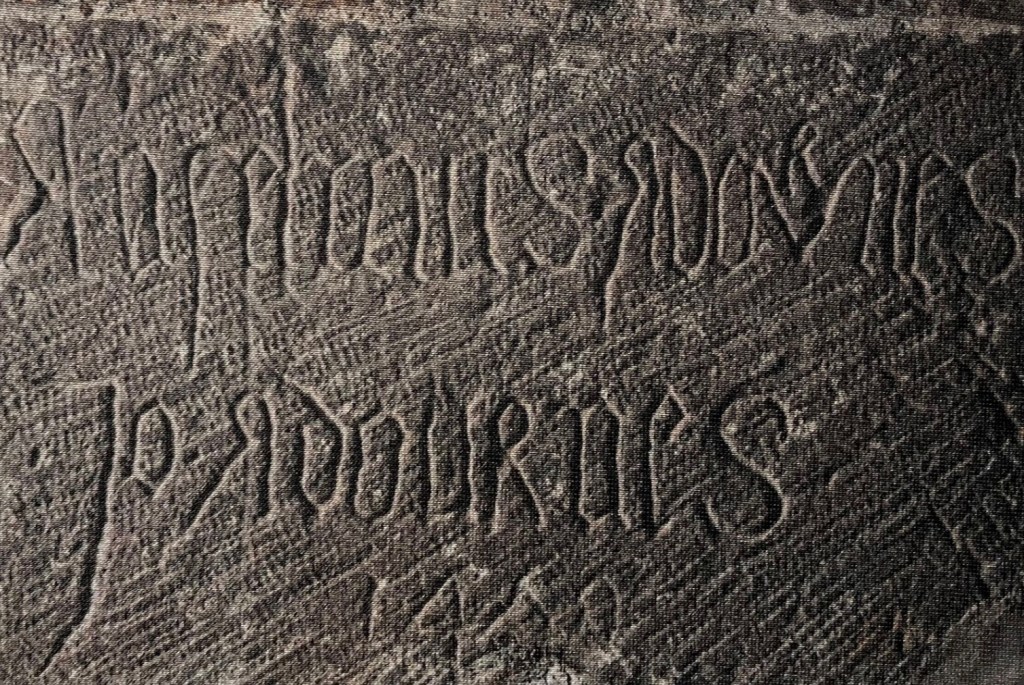
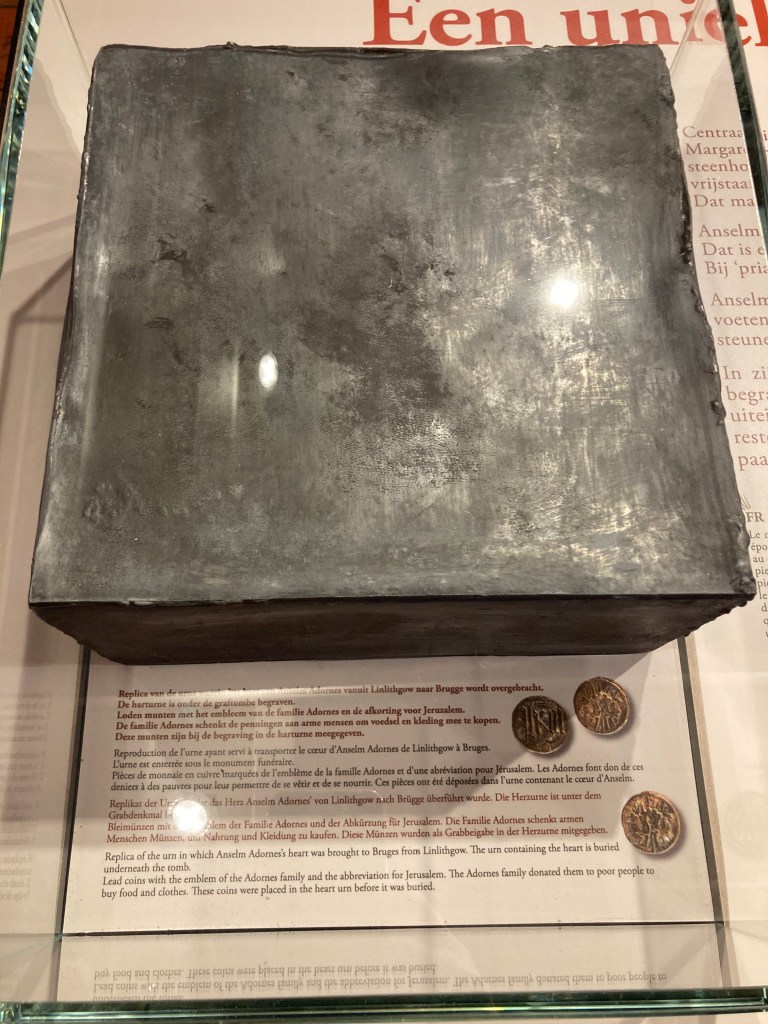
However, an uprising erupted in Bruges in 1477 and he was arrested twice, tortured and accused of self-enrichment. Anselm had to pay a severe fine and he left Bruges for Scotland. This was to prove fatal. Although he quickly re-established himself as one of James III’s close companions, was appointed keeper of the king’s palace at Linlithgow and survived the rebellion against the king in 1482, he was murdered in the following year in circumstances which remain obscure. His body is interred at Linlithgow, Scotland but his heart was returned to Bruges to be buried alongside his wife in the Jerusalem Chapel. Extraordinary.
A diplomat, politician, trader & pilgrim, Anselme is considered a humanist. During his travels, he showed great interest for other cultures that were considered equal. “There is only one road to heaven, and it is equally long from all corners of the world“, his son wrote in his account of their travels to the Middle East. A truly extraordinary place to visit.
Not to forget that Anselme Adornes was also a benefactor of the poor. The museum in the grounds of the Jerusalem Chapel was built initially by him as alms houses for women in need that were still in use until the 1970s!
Equally extraordinary is the fact that the current owners of the Chapel are the 17th Generation of the Adornes family. What longevity!
3. Saint John’s Hospital a place of care and caring since the 12th century
Located in the centre of Bruges beside the Church of Our Lady, the visitor will find the magnificent Saint John’s Hospital (Old Sint-Janshospitaal) which houses a collection of paintings, triptychs & reliquaries by one of the figureheads of 14th century Flemish Primitive artists, Hans Memling who moved to Bruges in 1460 and who created 4 of his 7 masterpieces in the hospital. Founded in the 12th century, the Hospital grew in the Middle Ages and was a place where sick pilgrims and travellers were cared for. Amazingly, a part of the hospital was still in use up to 1977. The Hospital houses an exhibition dedicated to medical care through the centuries and visitors can discover with some anguish the medical care delivered over the centuries for illnesses such as kidney stones, cholera, the plague,…..Not for the squeamish.
Saint John’s Hospital reminds current day visitors that “hospitality is the art of receiving guests and that the hospital was a home, a shelter for people in need. The paintings in the collection provide for this art of hospitality do’s and don’ts for those who receive guests. Put good food on the table? Do, of course. Turn people away for being different? Don’t“. A wonderful visit.
4. The Book of Hours at the Groeningemuseum
Despite the booming trade and commercial growth, the 14th and 15th centuries were hard times indeed for Bruges’ citizens with epidemics, famines and wars ravaging Europe. In uncertain times, faith provided a source of stability. More and more people could read and they could take their faith and salvation into their now hands through the use of small book of hours/prayer books.
At the Groeningemuseum, you can discover a fascinating exhibition entitled “Pride & Solace” (Trots en Troost) of these medieval prayer books used by rich and poor alike. Books of hours contained daily prayers recited by clergy in Church and the Hours were the 8 prescribed times of daily prayers: matins, lauds, prime, terce, sext, none, vespers and compline. In addition to the Books of Hours (perhaps on temporary display), you can discover masterpieces from Flemish masters Jan van Eyck & Jheronimus Bosch who painted “The Last Judgement” between 1495 & 1505. Extraordinarily beautiful and enriching.
5. The Belfry
Of course, a trip to Bruges without paying a visit to the famous Belfry in the Market square is impossible. First built in 1240, the upper part three times destroyed and three times rebuilt, it today stands at 83 meters in height. A narrow staircase of 366 steps leads to the top and it certainly is good exercise to climb up to the top.
Along the way, you can discover the treasury where the City’s charter was once stored behind double wrought-iron gates and further up can be found the music drum that controls the carillon of 47 bells weighing in total more than 27 tons. The Carillon plays on Wednesdays, Saturdays and Sundays. Once at the top, the panoramic view of Bruges is breathtaking. well worth the effort and after all, no pain, no gain.
6. Out & about in Bruges
Having visited all the great museums and monuments, it remains a joy just walking around the city and along the canals, works of art in themselves. The city centre is small and it is easy to find your way around. What is remarkable is the general cleanliness of the streets generally free from litter and graffitti and there are lots of parks and green spaces populated with swans, ducks, and other wild life. A place to stroll around. A special mention to the Café Vlissinghe in Blekkerstraat, serving customers apparently since 1515. We recommend the Flemish carbonade. Eet smakelijk. Bon appétit!
Een prachtig verblijf in een prachtige stad. A beautiful stay in a beautiful city. We will definitely return. Win zullen terugkeren. Uitstekend.
Tags: Anselme Adornes, Art, Belgium, Bruges, Culture, Discovery, Europe, European Union, Flanders, Flemish painters, Hans Memling, History, Jan Van Eyck, music, Personal effectiveness, photography, Travel, Wellness
 OneWorld - Joseph Noone's Blog
Leave a comment